![[sex-vs-games.png]](https://blogger.googleusercontent.com/img/b/R29vZ2xl/AVvXsEiWT6mbsAd8KafuKD2PP-QO_YwLCsN9aWMSDAKQFz0tb7OlIoqxLeE4eJWqf5ga9tJUfeqgnDIIpPXsF5vBXz0wFFY48YcPO6mptfhjBIiDbXOWFz3dLI5Z-P2Ssi5Ba3YsVWEOWA/s1600-h/sex-vs-games.png)
Showing posts with label Guest. Show all posts
Showing posts with label Guest. Show all posts
Jan 19, 2007
Rumble | Sex Versus Videogames
I know which one I would choose...
![[sex-vs-games.png]](https://blogger.googleusercontent.com/img/b/R29vZ2xl/AVvXsEiWT6mbsAd8KafuKD2PP-QO_YwLCsN9aWMSDAKQFz0tb7OlIoqxLeE4eJWqf5ga9tJUfeqgnDIIpPXsF5vBXz0wFFY48YcPO6mptfhjBIiDbXOWFz3dLI5Z-P2Ssi5Ba3YsVWEOWA/s1600/sex-vs-games.png)
And it looks like Google agrees. Apparently the number of searches for sex on Google is so incomprehensibly vast that videogames barely even register in comparison. Here's a link to the trend search for you to see for yourself: http://www.google.com/trends?q=sex%2C+videogames&ctab=0&geo=all&date=all


Jan 17, 2007
Back In Business
I'm back in the land of the fatties, and the Game Crush command center has already been re-established on American soil. Expect an almost DAILY stream of news, views, analysis, and shitty jokes from here on out! In the past month or so we've been a bit lax about getting things up on the old blog here, but, realistically, there hasn't been a damn thing happening anyway. Lost Planet came out, I haven't gotten to play it yet, people have been calling PC gaming dead, they're mostly idiots, Jack Thompson is still an enormous jackass, Raph Koster is still fat, etc. 2006 is over, the march of time drives us one year closer to our inevitable, respective dooms, and Eddie insists on listening to the crappiest, most ancient music possible a few feet behind me. Luckily, I have plenty of, admittedly, barely not-revolting Red Stripe to drink to keep me tranquilized. Barring any explosions of murderous rage, Game Crush is going to be in your face in 2007 like a crazy rottweiler that chews it's way through your damn front door and scares the hell out of you while shitting all over your living room. That's how we roll.
Jan 6, 2007
Nintendo Moving To Korea
Recently, as reported by the Korean newspaper JoongAng Daily, Nintendo's president Satoru Iwata announced intentions to expand the company into the South Korean market. This may come as a surprise to many, considering that Nintendo products reach much of the rest of the world and the fact that translating between Korean and Japanese is relatively simple, both languages possessing nearly identical grammar. So why hasn't Nintendo been active in Korea up until this point, and what is the significance of this announcement? I've spent some time in Korea and I believe I may have some answers.

As a nation with one of the highest per capita rates of broadband penetration in the world, South Korea is obviously both technologically capable and rich enough to be a valuable market for foreign consumer electronics. However, the availability of broadband is telling. In fact, South Korean gaming culture is drastically different from what is common in the United States or Japan. Consoles and home gaming are not the norm, nor are arcades. Instead, the cities of South Korea are dotted with PC Bangs, or internet cafes, that are so numerous and inexpensive as to make any other method of gaming irrelevant. The last time I was in Seoul, I often stopped at PC Bangs throughout the day to contact people or check my e-mail. At every place I've been to, the price has been set at roughly a dollar per hour, and everytime I've gone the places have been full of gamers playing homegrown Korean MMOs or Counter Strike clones together, cheering and yelling. The gaming culture is actually incredibly social there, more akin to Eastern Europe than any other place I know of.

This socialness is a vital aspect of South Korean culture. I've heard it said that a Korean person would rather go hungry than eat alone, and it may seem to be an exageration, but I can't remember ever seeing a Korean person actually eating alone in Seoul. Perhaps some of the same social pressures apply to the gaming culture there. So the question must be asked, what does Nintendo have to offer to Korea, a culture that has its own style of play and has shown incredible acumen developing games suited to Korean tastes?
My initial answer was not much, honestly, but then I gave it a bit more thought. The barriers to widespread adoption of Nintendo products in Korea are many, the universal availability of the PC Bangs, places to meet friends and play together, coupled with a nationalistic competitiveness between Korean and Japanese products may make things very difficult for Nintendo to overcome. In fact, I'm not sure I can really see home consoles taking off excessively in South Korea anytime soon. However, the wireless capabilities of the DS and its portability may present a compelling opportunity for game developers in Korea. Nintendo has already announced its intentions to work closely with Korean developers, and the idea of porting popular Korean MMOs or creating new ones for play on the go to either the DS or the Wii may lure a number of developers. The potential to reach enormous foreign console markets alone may be a powerful draw. Once Korean games are on Nintendo systems, the systems themselves would become much more valuable to Korean consumers, leading perhaps to the same sort of universal adoption of the DS that Japan has already displayed (they are ALWAYS sold out). Time will tell whether or not the Korean public will embrace Nintendo products, but there are clearly many IPs that would be easily ported, such as Ragnarok Online or Maple Story, and I for one look forward to playing them on a DS at some point in the near future.

As a nation with one of the highest per capita rates of broadband penetration in the world, South Korea is obviously both technologically capable and rich enough to be a valuable market for foreign consumer electronics. However, the availability of broadband is telling. In fact, South Korean gaming culture is drastically different from what is common in the United States or Japan. Consoles and home gaming are not the norm, nor are arcades. Instead, the cities of South Korea are dotted with PC Bangs, or internet cafes, that are so numerous and inexpensive as to make any other method of gaming irrelevant. The last time I was in Seoul, I often stopped at PC Bangs throughout the day to contact people or check my e-mail. At every place I've been to, the price has been set at roughly a dollar per hour, and everytime I've gone the places have been full of gamers playing homegrown Korean MMOs or Counter Strike clones together, cheering and yelling. The gaming culture is actually incredibly social there, more akin to Eastern Europe than any other place I know of.

This socialness is a vital aspect of South Korean culture. I've heard it said that a Korean person would rather go hungry than eat alone, and it may seem to be an exageration, but I can't remember ever seeing a Korean person actually eating alone in Seoul. Perhaps some of the same social pressures apply to the gaming culture there. So the question must be asked, what does Nintendo have to offer to Korea, a culture that has its own style of play and has shown incredible acumen developing games suited to Korean tastes?
My initial answer was not much, honestly, but then I gave it a bit more thought. The barriers to widespread adoption of Nintendo products in Korea are many, the universal availability of the PC Bangs, places to meet friends and play together, coupled with a nationalistic competitiveness between Korean and Japanese products may make things very difficult for Nintendo to overcome. In fact, I'm not sure I can really see home consoles taking off excessively in South Korea anytime soon. However, the wireless capabilities of the DS and its portability may present a compelling opportunity for game developers in Korea. Nintendo has already announced its intentions to work closely with Korean developers, and the idea of porting popular Korean MMOs or creating new ones for play on the go to either the DS or the Wii may lure a number of developers. The potential to reach enormous foreign console markets alone may be a powerful draw. Once Korean games are on Nintendo systems, the systems themselves would become much more valuable to Korean consumers, leading perhaps to the same sort of universal adoption of the DS that Japan has already displayed (they are ALWAYS sold out). Time will tell whether or not the Korean public will embrace Nintendo products, but there are clearly many IPs that would be easily ported, such as Ragnarok Online or Maple Story, and I for one look forward to playing them on a DS at some point in the near future.
Dec 22, 2006
What's In The News
As many of you have no doubt been seeing, regular PS3 sales seem to be slowing down and the purchase prices on Ebay have been steadily declining. Perhaps due to the initial scarcity, there was a perceived demand for the PS3 that is not being borne out in current sales. Based on this perceived demand retailers took the opportunity to force consumers looking for the PS3 to buy fabulously expensive bundles and Ebayers gouged the rich for all they were worth. Maybe out of general frustration from these practices, or maybe because $600 is just too damn much to pay for a videogame system, consumers are walking. Where are they going? To the checkout line with their brand new Wiis.
Now, I think the Wii costs too much for the technology it uses, but I feel like it's almost a foregone conclusion that the DS effect is going to strike again. That's where Nintendo makes a simple system from matured technologies and the system is basically compelling to pretty much everybody. It isn't ridiculously cheap, but it's easily within most peoples' price ranges, even the somewhat thrifty, and it just plain looks fun. So it ends up being almost an impulse buy for millions of people that may not have been willing to purchase a traditional, complicated-looking system in the first place. The videogame market eluded Nintendo for the past two console generations so Nintendo just brings everybody back down to their level. Whether or not this will result in better games or mass-marketed crap aimed at old little kids and old people remains to be seen.
Reports are coming in that Blue Dragon sales in Japan have rapidly dropped as well. Last week over 80,000 units were sold according to Media Create, but this week Blue Dragon isn't even in the charts anymore. My theory is that every Japanese person that owns a 360 bought a copy, and now it's pretty much done. 80,000 is far less than what's needed to break even on development costs, especially a title with so many top class developers working on it. After localization, the sales in western markets will most likely be awesome though, so it could still turn out to be a hit overall.
In other news, I'm heading to America next month, so all readers in all major American cities prepare yourself for the coming onslaught!
Now, I think the Wii costs too much for the technology it uses, but I feel like it's almost a foregone conclusion that the DS effect is going to strike again. That's where Nintendo makes a simple system from matured technologies and the system is basically compelling to pretty much everybody. It isn't ridiculously cheap, but it's easily within most peoples' price ranges, even the somewhat thrifty, and it just plain looks fun. So it ends up being almost an impulse buy for millions of people that may not have been willing to purchase a traditional, complicated-looking system in the first place. The videogame market eluded Nintendo for the past two console generations so Nintendo just brings everybody back down to their level. Whether or not this will result in better games or mass-marketed crap aimed at old little kids and old people remains to be seen.
Reports are coming in that Blue Dragon sales in Japan have rapidly dropped as well. Last week over 80,000 units were sold according to Media Create, but this week Blue Dragon isn't even in the charts anymore. My theory is that every Japanese person that owns a 360 bought a copy, and now it's pretty much done. 80,000 is far less than what's needed to break even on development costs, especially a title with so many top class developers working on it. After localization, the sales in western markets will most likely be awesome though, so it could still turn out to be a hit overall.
In other news, I'm heading to America next month, so all readers in all major American cities prepare yourself for the coming onslaught!
Dec 20, 2006
Jump Festa 2007 Special
Jump Festa is an annual show hosted by Jump Shueisha, the publishers of the incredibly popular Shounen Jump magazine, a collection of Japanese manga, or comics, such as Naruto and Bleach that comes out in both weekly and monthly editions. Jump Festa is primarily an event intended to showcase popular manga and characters, and provide an opportunity for some fan interaction with cosplay exhibitions, but videogame companies usually make a strong showing as well since they're aiming at the same demographics. In fact, the Jump properties feature prominently in games across nearly all the different consoles.

This year, Jump Festa took place at the Makuhari Messe auditorium in Chiba prefecture, on Saturday and Sunday, December 16th and 17th. I made it out to Chiba to cover the event and it turned out to be an awesome day. I woke up early on Saturday morning in order to make it on time for the 9AM opening. When I stepped off the train at the Kaihin Makuhari station, within walking distance of the auditorium, I found myself already being ushered along by an enormous crowd all headed in the same direction. Luckily, when I actually arrived at the auditorium, it wasn't even close to packed. Calling the Makuhari Messe center an auditorium is an understatement. It's more like a series of three football field sized showfloors, dotted with gigantic inflatables of Naruto, Goku from Dragon Ball Z, and other famous Jump characters. The cosplayers were still just filtering in, but by lunchtime I found myself crouched on the concrete, eating soba noodles next to Cloud and Reno from Final Fantasy 7 in a forest of gargantuan, brightly-colored, inflatable people. This is exactly why I came to Japan.

Videogame booths were everywhere on the showfloors, and appeared to be the main attractions. In fact, it looked as if no expense had been spared in constructing these enormous, flashing mini-habitats to grab your attention. For the Wii, Nintendo constructed a series of living rooms for you to wait in line by, while a strange man in a bright green suit randomly accosted the diligent to play Magic Taisen, a game for the DS that lets you perform magic tricks. The most enormous and overdone booth was without a doubt Square-Enix's, though. Less a booth than a series of several enormous booths each staffed with their own attendants with separate uniforms reflecting the clothing style from some Final Fantasy game or another, two movie theaters, and an enormous marquee sign flashing text taller than me all day. To top it all off, they threw in a giant inflatable Chocobo and a Slime from Dragon Quest to sit on top. If there hadn't been a roof over us, I'm sure this would have been the first videogame booth visible from space.


Jump Festa 2007 being a huge event, there were a lot of big announcements that are probably just now filtering out to the internet. Square-Enix really took advantage of this opportunity with news of a Final Fantasy: Tactics remake for the PSP, a sequel to FF:Tactics Advanced showing up on the DS, a mysterious, unnamed project marked for 2007, the original Front Mission game for cellphones and the DS, an updated version of the movie Final Fantasy Advent Children, a trailer for Kingdom Hearts Final Mix, a remake of Kingdom Hearts 2 for the PS2, and updated trailers for Final Fantasy XIII and others. The real draw though, was the set of games playable by the public for the first time ever. Here are some first impressions.

Crisis Core: Final Fantasy 7 (PSP) – Crisis Core is incredibly polished. Everything looked great, the story seemed to already have all of the voice-acting in place and the game looked mostly finished. In the demo I got to play, I played as the character Zack, a friend of Cloud's that appears in Advent Children. The demo allowed you to walk into town and fight Ifrit. The battle gameplay was good, with the ability to move Zack at will and execute commands such as using spells or items. When you choose the fight command though, Zack makes a beeline towards the enemy in which you can't control him in any way, so if you execute the command from far away he will definitely get hit. In the middle of the battle, Ifrit did an attack that seamlessly switched to video of him punching things wrapped in flames. Unfortunately, he did this move twice against me and I couldn't skip the video the second time around. Overall, though, Crisis Core looks amazingly good. This game may provide an enormous boost to PSP sales in Japan, where the system is very weak.

Seiken Densetsu 4: Dawn of Mana (PS2) – Dawn of Mana was looking really good. In the demo I played you start off in this brightly-colored paradise, populated by cute hopping bunnies and 3-legged wooly horse things. The paradise was shattered as I immediately set to destroying everything that moved, an act which was made easier by the main character's whip that allows you to grab and manipulate objects, spinning them and sending them flying into groups of enemies or just launching them straight out at the adorable, unsuspecting inhabitats. I can't wait to get this game. With no bunny rabbits left to smush, I headed out to fight the boss monster, an enormous creature that whipped me with his long arms. The attendant kept telling me to do something with the pumpkins all around him that I couldn't translate completely, but everytime I touched them they blew up on me, so I ended up running out of time before beating the boss.

Subarashiki Kono Sekia: A Wonderful World (DS) – This handheld game features a semi-realistic Tokyo in which you play as a character that travels around using psychic powers to defeat strange creatures that happen to just be hanging out. There are two main characters, and you primarily control the boy, although in some battles there is secondary action going on on the upper screen where you must occasionally manipulate the girl to enable you to fight the enemy in the lower screen. The gameplay consists of you using the stylus to perform pyrokinesis to burn enemies, shock the enemy with lightning bolts, hit them directly, or use telekinesis to fling objects around. Sometimes it seemed as if the game was difficult to get to respond right, where I continually casted fire when I just wanted to hit the enemy, but overall it seems like a promising title.
Dragon Quest Sword (Wii) – Dragon Quest Sword is a first person Dragon Quest game where you travel along a more or less linear path with occasional branches, defeating enemies by using the Wii Remote to swing your sword, block with your shield, or shoot balls of magic. The game was very responsive and looked decent, if a bit simple. All the enemies were standard Dragon Quest fare, such as the Slime, the Golem, etc. The game was fun, but the girls in the booth were distractingly hot, so I may have missed a few things.
Lost Odyssey (360) – This Mistwalker title looked promising from a distance, but up close the game failed to impress. There wasn't much of a crowd gathered at all, at any of the 360 booths really, so there wasn't much of a wait to play. Lost Odyssey is an RPG set in a strange alternate universe of technology and magic where you play as a silent warrior sword-fighting with an entire army, apparently by himself. You end up fighting a giant machine that shoots flames, but the combat was a bit slow and I don't think many of the players at the booth figured out how to use the Power Drink item, as most of them ended up just walking away early on. I stayed and beat the machine to get treated to Lost Odyssey's partially broken texture-loading on the world map. I then encountered some other soldiers in absurd helmets that ushered me on to a town of some sort, before getting booted off the machine due to time limits.
Strange Dragonball Z Game (I don't know the name of the system) – I was walking around and I saw a bunch of little kids spazzing out playing some sort of Dragonball Z game where you wore little sensors on your hands and opened and closed your fist in front of a camera to attack. The attendant there must have confused my confusion with interest, because he gestured for me to come give it a try. Luckily, I have a strong ability to turn off my embarassment reflexes, so I, of course, agreed. All in the name of journalism! Unfortunately, the camera was set at the height of children, so I had to half crouch to play, but the game consisted of me opening and closing my hands to launch little energy balls at the enemy while he flew around and attempted to hit me. You use your energy balls to deflect his shots or pinpoint his weak spots to halt his attacks. I'm proud to say I utterly crushed my opponent. Piccolo would be proud.
There were many other games, but I only got to play them briefly. A Chocobo game for the cellphone seemingly instantly imploded from my touch, so I quickly fled. Then the attendants began closing everything up by around 5PM. Jump Festa 2007 turned out to be a lot of line-waiting punctuated by a few minutes of gameplay, but the spiky-haired cosplayers made the waiting bearable, so the event was pretty enjoyable. Hopefully these first impressions will give everybody some new games to eagerly anticipate heading into 2007.


This year, Jump Festa took place at the Makuhari Messe auditorium in Chiba prefecture, on Saturday and Sunday, December 16th and 17th. I made it out to Chiba to cover the event and it turned out to be an awesome day. I woke up early on Saturday morning in order to make it on time for the 9AM opening. When I stepped off the train at the Kaihin Makuhari station, within walking distance of the auditorium, I found myself already being ushered along by an enormous crowd all headed in the same direction. Luckily, when I actually arrived at the auditorium, it wasn't even close to packed. Calling the Makuhari Messe center an auditorium is an understatement. It's more like a series of three football field sized showfloors, dotted with gigantic inflatables of Naruto, Goku from Dragon Ball Z, and other famous Jump characters. The cosplayers were still just filtering in, but by lunchtime I found myself crouched on the concrete, eating soba noodles next to Cloud and Reno from Final Fantasy 7 in a forest of gargantuan, brightly-colored, inflatable people. This is exactly why I came to Japan.

Videogame booths were everywhere on the showfloors, and appeared to be the main attractions. In fact, it looked as if no expense had been spared in constructing these enormous, flashing mini-habitats to grab your attention. For the Wii, Nintendo constructed a series of living rooms for you to wait in line by, while a strange man in a bright green suit randomly accosted the diligent to play Magic Taisen, a game for the DS that lets you perform magic tricks. The most enormous and overdone booth was without a doubt Square-Enix's, though. Less a booth than a series of several enormous booths each staffed with their own attendants with separate uniforms reflecting the clothing style from some Final Fantasy game or another, two movie theaters, and an enormous marquee sign flashing text taller than me all day. To top it all off, they threw in a giant inflatable Chocobo and a Slime from Dragon Quest to sit on top. If there hadn't been a roof over us, I'm sure this would have been the first videogame booth visible from space.


Jump Festa 2007 being a huge event, there were a lot of big announcements that are probably just now filtering out to the internet. Square-Enix really took advantage of this opportunity with news of a Final Fantasy: Tactics remake for the PSP, a sequel to FF:Tactics Advanced showing up on the DS, a mysterious, unnamed project marked for 2007, the original Front Mission game for cellphones and the DS, an updated version of the movie Final Fantasy Advent Children, a trailer for Kingdom Hearts Final Mix, a remake of Kingdom Hearts 2 for the PS2, and updated trailers for Final Fantasy XIII and others. The real draw though, was the set of games playable by the public for the first time ever. Here are some first impressions.

Crisis Core: Final Fantasy 7 (PSP) – Crisis Core is incredibly polished. Everything looked great, the story seemed to already have all of the voice-acting in place and the game looked mostly finished. In the demo I got to play, I played as the character Zack, a friend of Cloud's that appears in Advent Children. The demo allowed you to walk into town and fight Ifrit. The battle gameplay was good, with the ability to move Zack at will and execute commands such as using spells or items. When you choose the fight command though, Zack makes a beeline towards the enemy in which you can't control him in any way, so if you execute the command from far away he will definitely get hit. In the middle of the battle, Ifrit did an attack that seamlessly switched to video of him punching things wrapped in flames. Unfortunately, he did this move twice against me and I couldn't skip the video the second time around. Overall, though, Crisis Core looks amazingly good. This game may provide an enormous boost to PSP sales in Japan, where the system is very weak.

Seiken Densetsu 4: Dawn of Mana (PS2) – Dawn of Mana was looking really good. In the demo I played you start off in this brightly-colored paradise, populated by cute hopping bunnies and 3-legged wooly horse things. The paradise was shattered as I immediately set to destroying everything that moved, an act which was made easier by the main character's whip that allows you to grab and manipulate objects, spinning them and sending them flying into groups of enemies or just launching them straight out at the adorable, unsuspecting inhabitats. I can't wait to get this game. With no bunny rabbits left to smush, I headed out to fight the boss monster, an enormous creature that whipped me with his long arms. The attendant kept telling me to do something with the pumpkins all around him that I couldn't translate completely, but everytime I touched them they blew up on me, so I ended up running out of time before beating the boss.

Subarashiki Kono Sekia: A Wonderful World (DS) – This handheld game features a semi-realistic Tokyo in which you play as a character that travels around using psychic powers to defeat strange creatures that happen to just be hanging out. There are two main characters, and you primarily control the boy, although in some battles there is secondary action going on on the upper screen where you must occasionally manipulate the girl to enable you to fight the enemy in the lower screen. The gameplay consists of you using the stylus to perform pyrokinesis to burn enemies, shock the enemy with lightning bolts, hit them directly, or use telekinesis to fling objects around. Sometimes it seemed as if the game was difficult to get to respond right, where I continually casted fire when I just wanted to hit the enemy, but overall it seems like a promising title.
Dragon Quest Sword (Wii) – Dragon Quest Sword is a first person Dragon Quest game where you travel along a more or less linear path with occasional branches, defeating enemies by using the Wii Remote to swing your sword, block with your shield, or shoot balls of magic. The game was very responsive and looked decent, if a bit simple. All the enemies were standard Dragon Quest fare, such as the Slime, the Golem, etc. The game was fun, but the girls in the booth were distractingly hot, so I may have missed a few things.
Lost Odyssey (360) – This Mistwalker title looked promising from a distance, but up close the game failed to impress. There wasn't much of a crowd gathered at all, at any of the 360 booths really, so there wasn't much of a wait to play. Lost Odyssey is an RPG set in a strange alternate universe of technology and magic where you play as a silent warrior sword-fighting with an entire army, apparently by himself. You end up fighting a giant machine that shoots flames, but the combat was a bit slow and I don't think many of the players at the booth figured out how to use the Power Drink item, as most of them ended up just walking away early on. I stayed and beat the machine to get treated to Lost Odyssey's partially broken texture-loading on the world map. I then encountered some other soldiers in absurd helmets that ushered me on to a town of some sort, before getting booted off the machine due to time limits.
Strange Dragonball Z Game (I don't know the name of the system) – I was walking around and I saw a bunch of little kids spazzing out playing some sort of Dragonball Z game where you wore little sensors on your hands and opened and closed your fist in front of a camera to attack. The attendant there must have confused my confusion with interest, because he gestured for me to come give it a try. Luckily, I have a strong ability to turn off my embarassment reflexes, so I, of course, agreed. All in the name of journalism! Unfortunately, the camera was set at the height of children, so I had to half crouch to play, but the game consisted of me opening and closing my hands to launch little energy balls at the enemy while he flew around and attempted to hit me. You use your energy balls to deflect his shots or pinpoint his weak spots to halt his attacks. I'm proud to say I utterly crushed my opponent. Piccolo would be proud.
There were many other games, but I only got to play them briefly. A Chocobo game for the cellphone seemingly instantly imploded from my touch, so I quickly fled. Then the attendants began closing everything up by around 5PM. Jump Festa 2007 turned out to be a lot of line-waiting punctuated by a few minutes of gameplay, but the spiky-haired cosplayers made the waiting bearable, so the event was pretty enjoyable. Hopefully these first impressions will give everybody some new games to eagerly anticipate heading into 2007.


Dec 19, 2006
Little Big Boss -- Metal Gear Solid: Portable Ops Review
Portable Ops is what I would call Metal Gear Lite. The first handheld iteration of the Metal Gear Solid series to feature the traditional sneaking and shooting gameplay, with Portable Ops Kojima Productions have attempted to shoehorn a direct sequel to MGS3 onto the PSP and have fantastically succeeded. PO is without a doubt my current favorite game for the PSP, and, I would even venture, the single best game the system has seen so far. That being said, PO is still a radical departure from the format of the console entries.
Technically, PO shines. The graphics aren't quite up to par with MGS2 or 3 for the PS2. They tend to be simpler, and textures occasionally appear pixelated, but that's really the only significant graphical complaint I can make. For a handheld game, PO looks great, with nicely detailed character models and not a hint of slowdown even with many enemies on screen. Perhaps some areas end up looking a bit bland, as a result of having many of the environmental effects and soft lighting from MGS3 stripped out, but PO proves its chops during certain climactic battles. What PO elevates to high art, however, is the menu. This game's menus are brilliant. Everything looks slick and makes cool little sounds. The overall presentation of this game is flawless.

The cut scenes aren't full 3D like the console titles, but are instead stylishly done comic book art, with minor animation thrown in. These usually look decent, and they generally do a good job conveying the story. The voice-acting in particular, though, is very well done. David Hayter, the voice of Snake, appears to have gone for something a little bit less gruff this time around, but the general interaction between all the actors is natural sounding and emotional. The enemy radio chatter is pretty good as well. Overall, the sound is regular Kojima fare, which, of course, means really well-done. These are the MGS sounds you are used to, and they still work great.
Control-wise, there are a few issues. In making the jump to PSP, there is one less analog stick to use for control, so camera sometimes becomes an issue. Kojima Productions makes it somewhat easier by allowing you to completely configure your controls, resulting in my being able to come to an acceptable compromise, but, in my case, the lack of complete freedom of control of the camera while moving sometimes made things difficult for me. It was not a continual and glaring annoyance, just something that frustrated me a few times where I needed to aim my character more exactly and couldn't depend on seeing where I was going. With the customizability of the controls, however, every player is free to figure it out for themselves. I actually configured mine to play entirely in first person mode for awhile, just to try it out, but it didn't end up working so well.

The story is fairly solid. Sort of a truncated mix of the murderous battlefield drama and emotional exposition of the console versions, PO tells you the story of Big Boss following MGS3. The story is significant, in that it unveils some of the vital points in the Metal Gear time line, beginning to bridge the gap between MGS3 and the original Metal Gear for the NES, but it is a bit short. As usual, there is a ninja, but boss battles this time around are somewhat limited and the mythology of the Metal Gear series, with its usual collection of emotionally scarred but supernatural warriors, is reduced to just a few supernatural soldiers this time around. The same elements are present, just in smaller amounts.
The way the story unfolds, however, is where PO diverges from the console games. In Portable Ops, the essential gameplay within an individual mission is the same, but everything is broken up into bite-sized maps that can be completed in a shorter period of time, making PO much more convenient as a portable title. The gameplay is open-ended in that you can choose which maps to go to, leaving the actual progression of the story for later if you wish. Between missions you can save and manage your team. That's right, I said team.
In PO you get the chance to build an army. As you go from map to map executing missions, you have the option of abducting enemy soldiers and convincing them to join you. By the end of the game, I had a vast network of spies delivering reports on every map area for me to investigate, a workshop full of technicians building me weapons and ammunition, doctors making sure I'm nice and healthy at all times, and a squad of the finest killing machines ever seen. Inside each mission, you can bring a squad of up to four soldiers that you can switch between dynamically. Item slots are limited, so you really benefit from specializing each member for a specific role.
So how does the game play? Everything feels like classic Metal Gear Solid within the missions, the sneaking and the fighting are still fun. Once the recruitment push began, I found myself a bit obsessed with the process, often tranquilizing, beating, and choking entire maps of enemies unconscious, then dragging them back to my truck. At times dragging enemies around got a bit tedious, but once I figured out how to radio them in it wasn't a problem at all. You don't have to go through a convoluted process to treat your wounds this time around, thankfully, but you still have to deal with both stamina and health. The stamina running down coupled with the limited item slots occasionally results in annoyance. The boss fights are, sadly, much more direct and simple than is common with MGS, devolving into little more than outright shootouts, but they are still emotionally charged affairs, pitting former comrades and eternal rivals against one another.
Dealing with things from the map screen, you get the basic enjoyment of building an ever larger army, developing your own weapons, etc. Unfortunately, though, you don't really seem to build new and interesting weapons for use in the missions often enough. As your spies deliver reports on each map location, you end up getting a sort of repetitive series of side quests that follow the formula of procure the new weapon on this map here or rescue the detained soldier on this other map over here, PO's version of the fetch quest. That said, the strangely addictive quality of getting more soldiers and arming them with marginally better weapons keeps you going, and the maps are small and self-contained, allowing you to complete the objectives in a relatively short period of time anyway.

There are a few idiosyncrasies going on as well. You are executing sneaking missions, but you perform all actions from your truck, which acts as a mobile base. Each mission you go on, you pull up in your truck and hop out. How the enemies manage not to notice, I'm not sure, especially since the truck's wheels appear to be perfect hexagons, so you know it has to be making plenty of noise. Also, in Portable Ops' version of the 70's, the majority of doors sense your presence and slide open automatically. Soviet technology was formidable indeed. Humorously, all of your comrades that you deploy with hide in cardboard boxes strewn across the level. Luckily, the cardboard box is still the perfect disguise. Finally, this time around enemies seem to be utterly baffled by lockers. Even if you climb into the locker right in front of them, they are powerless to open it. The enemy will just run up to you then run away over and over again, as if desperately trying to decide what to do, before radioing in to headquarters that you've mysteriously disappeared, I imagine in an attempt to hide their shame.
The multiplayer aspect of PO seems very robust but, unfortunately, I was unable to find any opponents due to the fact that the Japanese version isn't out yet. What I could see is that there is a trading function that puts your PSP into sleep mode while it waits to pass another PSP waiting to trade, then you swap team members. There is also a direct battle mode where you play against other players online, and whether or not it is real or virtual mode, your characters that get killed are taken by the other player. Finally, there is a sort of simulation circuit where your team plays against other teams online, without the player doing anything.
Long story short, MGS: PO is undoubtedly one of the best PSP games yet, and a solid, but somewhat non-traditional, addition to the MGS series. Though somewhat short on the MGS series' traditional pantheon of inhuman boss characters to puzzle out how to beat, it's polished, fun, and delivers in all aspects. I have no qualms recommending this game unconditionally to any PSP owner. I give MGS:PO my highest score, 2 stars.
**
Technically, PO shines. The graphics aren't quite up to par with MGS2 or 3 for the PS2. They tend to be simpler, and textures occasionally appear pixelated, but that's really the only significant graphical complaint I can make. For a handheld game, PO looks great, with nicely detailed character models and not a hint of slowdown even with many enemies on screen. Perhaps some areas end up looking a bit bland, as a result of having many of the environmental effects and soft lighting from MGS3 stripped out, but PO proves its chops during certain climactic battles. What PO elevates to high art, however, is the menu. This game's menus are brilliant. Everything looks slick and makes cool little sounds. The overall presentation of this game is flawless.

The cut scenes aren't full 3D like the console titles, but are instead stylishly done comic book art, with minor animation thrown in. These usually look decent, and they generally do a good job conveying the story. The voice-acting in particular, though, is very well done. David Hayter, the voice of Snake, appears to have gone for something a little bit less gruff this time around, but the general interaction between all the actors is natural sounding and emotional. The enemy radio chatter is pretty good as well. Overall, the sound is regular Kojima fare, which, of course, means really well-done. These are the MGS sounds you are used to, and they still work great.
Control-wise, there are a few issues. In making the jump to PSP, there is one less analog stick to use for control, so camera sometimes becomes an issue. Kojima Productions makes it somewhat easier by allowing you to completely configure your controls, resulting in my being able to come to an acceptable compromise, but, in my case, the lack of complete freedom of control of the camera while moving sometimes made things difficult for me. It was not a continual and glaring annoyance, just something that frustrated me a few times where I needed to aim my character more exactly and couldn't depend on seeing where I was going. With the customizability of the controls, however, every player is free to figure it out for themselves. I actually configured mine to play entirely in first person mode for awhile, just to try it out, but it didn't end up working so well.

The story is fairly solid. Sort of a truncated mix of the murderous battlefield drama and emotional exposition of the console versions, PO tells you the story of Big Boss following MGS3. The story is significant, in that it unveils some of the vital points in the Metal Gear time line, beginning to bridge the gap between MGS3 and the original Metal Gear for the NES, but it is a bit short. As usual, there is a ninja, but boss battles this time around are somewhat limited and the mythology of the Metal Gear series, with its usual collection of emotionally scarred but supernatural warriors, is reduced to just a few supernatural soldiers this time around. The same elements are present, just in smaller amounts.
The way the story unfolds, however, is where PO diverges from the console games. In Portable Ops, the essential gameplay within an individual mission is the same, but everything is broken up into bite-sized maps that can be completed in a shorter period of time, making PO much more convenient as a portable title. The gameplay is open-ended in that you can choose which maps to go to, leaving the actual progression of the story for later if you wish. Between missions you can save and manage your team. That's right, I said team.
In PO you get the chance to build an army. As you go from map to map executing missions, you have the option of abducting enemy soldiers and convincing them to join you. By the end of the game, I had a vast network of spies delivering reports on every map area for me to investigate, a workshop full of technicians building me weapons and ammunition, doctors making sure I'm nice and healthy at all times, and a squad of the finest killing machines ever seen. Inside each mission, you can bring a squad of up to four soldiers that you can switch between dynamically. Item slots are limited, so you really benefit from specializing each member for a specific role.
So how does the game play? Everything feels like classic Metal Gear Solid within the missions, the sneaking and the fighting are still fun. Once the recruitment push began, I found myself a bit obsessed with the process, often tranquilizing, beating, and choking entire maps of enemies unconscious, then dragging them back to my truck. At times dragging enemies around got a bit tedious, but once I figured out how to radio them in it wasn't a problem at all. You don't have to go through a convoluted process to treat your wounds this time around, thankfully, but you still have to deal with both stamina and health. The stamina running down coupled with the limited item slots occasionally results in annoyance. The boss fights are, sadly, much more direct and simple than is common with MGS, devolving into little more than outright shootouts, but they are still emotionally charged affairs, pitting former comrades and eternal rivals against one another.
Dealing with things from the map screen, you get the basic enjoyment of building an ever larger army, developing your own weapons, etc. Unfortunately, though, you don't really seem to build new and interesting weapons for use in the missions often enough. As your spies deliver reports on each map location, you end up getting a sort of repetitive series of side quests that follow the formula of procure the new weapon on this map here or rescue the detained soldier on this other map over here, PO's version of the fetch quest. That said, the strangely addictive quality of getting more soldiers and arming them with marginally better weapons keeps you going, and the maps are small and self-contained, allowing you to complete the objectives in a relatively short period of time anyway.

I found this picture on the internet, I have no clue how to get this character
There are a few idiosyncrasies going on as well. You are executing sneaking missions, but you perform all actions from your truck, which acts as a mobile base. Each mission you go on, you pull up in your truck and hop out. How the enemies manage not to notice, I'm not sure, especially since the truck's wheels appear to be perfect hexagons, so you know it has to be making plenty of noise. Also, in Portable Ops' version of the 70's, the majority of doors sense your presence and slide open automatically. Soviet technology was formidable indeed. Humorously, all of your comrades that you deploy with hide in cardboard boxes strewn across the level. Luckily, the cardboard box is still the perfect disguise. Finally, this time around enemies seem to be utterly baffled by lockers. Even if you climb into the locker right in front of them, they are powerless to open it. The enemy will just run up to you then run away over and over again, as if desperately trying to decide what to do, before radioing in to headquarters that you've mysteriously disappeared, I imagine in an attempt to hide their shame.
The multiplayer aspect of PO seems very robust but, unfortunately, I was unable to find any opponents due to the fact that the Japanese version isn't out yet. What I could see is that there is a trading function that puts your PSP into sleep mode while it waits to pass another PSP waiting to trade, then you swap team members. There is also a direct battle mode where you play against other players online, and whether or not it is real or virtual mode, your characters that get killed are taken by the other player. Finally, there is a sort of simulation circuit where your team plays against other teams online, without the player doing anything.
Long story short, MGS: PO is undoubtedly one of the best PSP games yet, and a solid, but somewhat non-traditional, addition to the MGS series. Though somewhat short on the MGS series' traditional pantheon of inhuman boss characters to puzzle out how to beat, it's polished, fun, and delivers in all aspects. I have no qualms recommending this game unconditionally to any PSP owner. I give MGS:PO my highest score, 2 stars.
**
Dec 13, 2006
Dragon Quest IX For The DS
The industry is abuzz with the recent announcement that Dragon Quest IX will be coming out for the Nintendo DS. Square-Enix has bucked the trend of releasing the next iterations of their flagship series exclusively on home consoles, and has made it clear that handhelds will be a perfectly acceptable fit. This bodes well for Nintendo, who are seemingly receiving a vindication of their strategies. Nintendo has enjoyed breakout success with their DS handhelds in a Japan that appears to be increasingly focussed on the more casual gameplay experience. Nintendo is taking the same approach with the Wii, focussing less on cutting-edge technology and more on creating a system that is instantly compelling in terms of look and interface. The Wii's success is not yet certain, but early indications tend to favor another massive success, with Nintendo most recently breaking console sales records in the UK. The movement of the Dragon Quest series to the DS may come as a slap in the face to Sony, but it makes perfectly good business sense from a publisher standpoint. The DS installed base is simply incredible and the development costs will be far lower than that of a PS3 title. It remains to be seen whether other large franchises will make the jump entirely to the DS in the future, or, perhaps, to the Wii, in a similar fashion.


Dec 11, 2006
Awesome Game Art
This is an awesome picture I found while browsing on DeviantArt by the user MikePMitchell, whose entire gallery kicks incredible ass.


Dec 10, 2006
Japan Spam: Top Fighter For The SNES
Here's a video of this weird sort of bootlegged game running on an SNES at the Akihabara location of Super Potato.
For those who don't know, Super Potato is a shop that specializes in older games, so you will see a huge selection of more old and obscure items than you can imagine. There are NES systems with the Japanese disk drive, old, pre-NES electronic games, piles and piles of Genesis, SNES, Virtual Boy, Saturn, and Neo Geo games, and lots of old strategy guides for all of them. Usually they have some 8-bit music playing out of their window when you walk past, so you know how to find them despite the fact that they are sort of hidden on the second floor and third floors of a building in a back-street off of Akihabara's main drag.
Here's another video I took the same day, last December. Cut out of this video for privacy purposes: the incredibly hot half-French girl I was with at the time. Just so you know who I was talking to.
I know that was too fast and blurry, and I left out some of the cooler things, such as the Nntendo 64 DD pack I found one day, but I haven't really recorded anything recently. I'll do a full breakdown on Akihabara someday, but for now enjoy this little glimpse into Super Potato. By the way, there is a Super Potato in Osaka as well, at the place called Den Den Town, so be sure to visit if you end up down there.
For those who don't know, Super Potato is a shop that specializes in older games, so you will see a huge selection of more old and obscure items than you can imagine. There are NES systems with the Japanese disk drive, old, pre-NES electronic games, piles and piles of Genesis, SNES, Virtual Boy, Saturn, and Neo Geo games, and lots of old strategy guides for all of them. Usually they have some 8-bit music playing out of their window when you walk past, so you know how to find them despite the fact that they are sort of hidden on the second floor and third floors of a building in a back-street off of Akihabara's main drag.
Here's another video I took the same day, last December. Cut out of this video for privacy purposes: the incredibly hot half-French girl I was with at the time. Just so you know who I was talking to.
I know that was too fast and blurry, and I left out some of the cooler things, such as the Nntendo 64 DD pack I found one day, but I haven't really recorded anything recently. I'll do a full breakdown on Akihabara someday, but for now enjoy this little glimpse into Super Potato. By the way, there is a Super Potato in Osaka as well, at the place called Den Den Town, so be sure to visit if you end up down there.
Dec 8, 2006
Site Changes, Japan Update
Site News
For all return visitors or people just coming in for the first time, I thought I'd explain some changes we've been making to the site. First off, we have our first podcast. You can expect more of these at a regular rate, however I'm not certain how to deal with hosting the mp3 file yet, so if anybody has a suggestion feel free to chime in. In addition, people who've been coming for awhile may have noticed the inclusion of separate news feeds in the sidebar. Basically, Eddie and I both use Google Reader to aggregate all of our rss feeds from different sites, it's a really efficient way to get updates without having to visit every single site and navigate through a ton of pages, so I highly recommend Google Reader or some other rss feed reader to those who haven't tried it out yet. Anyway, in Google Reader you get the option to share any items of interest you may come across, thus generating a separate feed of just those items you choose. With the little script that Google provides, we're now publishing these feeds on the sidebar, so you'll see them changing constantly. Unfortunately, our feeds only display 7 items at a time for the sake of not destroying the layout, so if you want to see everything we've shared you can either click to see more or subscribe to our feeds separately. I think I find a lot of awesome stuff so I really recommend you give it a try.
Japan News

The past few days have been a whirlwind of major releases in Japan. First, on November 30th, I was there to witness the rerelease of Final Fantasy 6 for the Gameboy Advance. This was actually a pretty big event, with displays all over Akihabara and awesome FF6 music playing wherever I went. FF6 had my favorite music of the series, so it was fun being out there. Pretty much every major store had stacks of copies, and sales seemed really brisk. The buzz for it was pretty strong, with even ShokoTan, the closest thing Akihabara has to a living mascot, releasing a picture of herself biting the box.

Then, on December 2nd, I was there for the Wii launch. Unfortunately, I had to teach a lesson that morning so I couldn't be there for the unveiling, but I was there in the aftermath. Of course, by the time I arrived there wasn't a single Wii to be had anywhere in the city. I asked some clerks in stores when they expect to get a new shipment of Wii's but none were able to give me a date. Interestingly, the Wii is actually quite a bit cheaper in Japan if you compare the exchange rate of Yen for Dollars. 25,000 Yen is about $217 USD. Unfortunately, Wii's aren't region-free though, so when I do manage to pick one up I'm going to have to play games entirely in Japanese. For most games that isn't a problem, but RPGs are hell.

Finally, there was the Blue Dragon launch. Buzz for this game has been good, I've been seeing package deals for it advertised in convenience stores, it got a great Famitsu score, and there are capsule toys and all types of little accessories out for it. The character design was done by Akira Toriyama, that's the artist who drew the Dragon Ball and Dragon Ball Z comics, the character designer behind Dragon Quest, Japan's other huge RPG series besides Final Fantasy, and the character designer behind Chrono Trigger. Unfortunately, it doesn't look like this was enough. Blue Dragon doesn't appear to be selling that many systems, or even that many copies. Unless some surprising news comes in about system sales, it appears Microsoft's single most hopeful gambit seems to have been unsuccessful. Rapid, widespread adoption of the console in Japan is still not happening, and that means serious Japanese developer support is still going to be limited. As long as the US and European developers provide quality titles like Gears of War, the system may do fine in the western markets, but it looks like this is shaping up to be one more console generation where Microsoft has failed to significantly penetrate to the east. It remains to be seen what other strategies Microsoft will take to make it over here.
Dec 6, 2006
Building The Universe In A Box
Following up on my previous article on emergent gameplay dynamics, I began to give some serious thought to creating a true sandbox RPG, that holy grail universe-in-a-box that grants the user infinite freedom to alter and even recreate new worlds to quest in, one where not even a single action or event is scripted.
Building on the notion of the simplified lexicon of overall actions and events, the developer's goal would be to construct a world similar to The Sims in that the characters all have needs and certain predilections. However, this would be adapted to a range of actions more suited to the RPG archetype. For instance, a character may, when affronted by another, opt to handle their differences with a swordfight. Again, the actual detail of the ouput would be limited, the days of an AI agent reading off their own poetry, generated in-game, are nowhere close, but there would be a generalized set of interactions around which the player would be able to construct their own story. Instead, the characters in our game may speak a sort of medieval babble, replete with taunts, triumphant sounding retorts, and the requisite evil laughter.
The basic economic system of our world would have to be more complex. Rather than purchasing lots and building modern homes like in The Sims, there would be a rudimentary commerce system, perhaps relying on just a few iconic goods, such as mined ores or magical energy even, that characters individually seek to gain more of and conduct trade with. In a degree of sophistication surpassing The Sims, the characters themselves would seek to purchase land, construct their own shops, and generally procure themselves a niche in the landscape. The distribution of resources across the land and presence of other settlements, as well as a given character's personality, would determine where they seek to settle, if at all. In fact, the attitude of each character would determine the nature of their interactions with others in many ways. Whereas some characters may go about the process of seeking wealth in a generally lawful manner, the villains would tend to take what they could where they could get away with it.
One interesting idea, besides the added complexity of AI real-estate development and a functional, although simplified economy, would be the opportunity to get away from the egalitarian social system of The Sims. Perhaps in our theoretical sandbox RPG, characters all fit into their own separate places in a feudalist system. This would radically change the nature of the social interactions in the game. Some AI agents would be compelled, to varying degrees, to help further the goals of other AI agents. There would be an added layer of abstraction between the direct experience of a need and the satisfaction of that need. For example, a character seeking to gain wealth may end up helping another character fight off some bandits, if that character has wealth to offer.
If we extrapolate the feudal social system out, our sandbox RPG can be understood as a system embodying competitive economic development where the total resources an individual character wields includes capability of production, actual holdings, and the fealty of other characters. One action in our simple lexicon of RPG actions may be for a villainous character to kidnap the family member of a wealthy character, hoping to extract a ransom. The wealthy character may then, in turn, issue a reward to ensure the safe return of their loved one, or even send out their own group of AI agents to find the kidnapper.
This is where the player character enters the picture. The player could be one of many separate entities attempting to get the reward. The limitations on what plot-twists arise would be limited only to the range of actions implemented in our RPG lexicon. Perhaps other, less scrupulous reward-seekers would attack the player character in an attempt to derail his/her efforts. The possible actions that could take place and all of the various resources and equipment in play are merely the basic elements of our game world. The way in which all of those elements combine would create a truly emergent story. In fact, the player may instead be the wealthy merchant issuing the reward, or even the one doing the kidnapping.
To create the complete universe in a box, we could pre-package our little world that we've grown and we could include the ability for the player to develop their own. Simply provide a few seed values, such as the amount of resources, population, etc., then allow the game itself to procedurally generate some terrain and some AI agents. When the world begins, the generated characters are all dropped in to seek out their own fortunes. Perhaps the world is aged to some degree, so that there are power structures already in place by the time the player decides to enter, or perhaps the player is there from the beginning. Either option would be possible. Once all the underlying game systems are in place, it wouldn't be incredibly difficult to lay a simple combat engine and some decent graphics on top, and our living, breathing RPG is complete. Any series of events could unfold, and the player would have the option of truly playing any role they wished.
Building on the notion of the simplified lexicon of overall actions and events, the developer's goal would be to construct a world similar to The Sims in that the characters all have needs and certain predilections. However, this would be adapted to a range of actions more suited to the RPG archetype. For instance, a character may, when affronted by another, opt to handle their differences with a swordfight. Again, the actual detail of the ouput would be limited, the days of an AI agent reading off their own poetry, generated in-game, are nowhere close, but there would be a generalized set of interactions around which the player would be able to construct their own story. Instead, the characters in our game may speak a sort of medieval babble, replete with taunts, triumphant sounding retorts, and the requisite evil laughter.
The basic economic system of our world would have to be more complex. Rather than purchasing lots and building modern homes like in The Sims, there would be a rudimentary commerce system, perhaps relying on just a few iconic goods, such as mined ores or magical energy even, that characters individually seek to gain more of and conduct trade with. In a degree of sophistication surpassing The Sims, the characters themselves would seek to purchase land, construct their own shops, and generally procure themselves a niche in the landscape. The distribution of resources across the land and presence of other settlements, as well as a given character's personality, would determine where they seek to settle, if at all. In fact, the attitude of each character would determine the nature of their interactions with others in many ways. Whereas some characters may go about the process of seeking wealth in a generally lawful manner, the villains would tend to take what they could where they could get away with it.
One interesting idea, besides the added complexity of AI real-estate development and a functional, although simplified economy, would be the opportunity to get away from the egalitarian social system of The Sims. Perhaps in our theoretical sandbox RPG, characters all fit into their own separate places in a feudalist system. This would radically change the nature of the social interactions in the game. Some AI agents would be compelled, to varying degrees, to help further the goals of other AI agents. There would be an added layer of abstraction between the direct experience of a need and the satisfaction of that need. For example, a character seeking to gain wealth may end up helping another character fight off some bandits, if that character has wealth to offer.
If we extrapolate the feudal social system out, our sandbox RPG can be understood as a system embodying competitive economic development where the total resources an individual character wields includes capability of production, actual holdings, and the fealty of other characters. One action in our simple lexicon of RPG actions may be for a villainous character to kidnap the family member of a wealthy character, hoping to extract a ransom. The wealthy character may then, in turn, issue a reward to ensure the safe return of their loved one, or even send out their own group of AI agents to find the kidnapper.
This is where the player character enters the picture. The player could be one of many separate entities attempting to get the reward. The limitations on what plot-twists arise would be limited only to the range of actions implemented in our RPG lexicon. Perhaps other, less scrupulous reward-seekers would attack the player character in an attempt to derail his/her efforts. The possible actions that could take place and all of the various resources and equipment in play are merely the basic elements of our game world. The way in which all of those elements combine would create a truly emergent story. In fact, the player may instead be the wealthy merchant issuing the reward, or even the one doing the kidnapping.
To create the complete universe in a box, we could pre-package our little world that we've grown and we could include the ability for the player to develop their own. Simply provide a few seed values, such as the amount of resources, population, etc., then allow the game itself to procedurally generate some terrain and some AI agents. When the world begins, the generated characters are all dropped in to seek out their own fortunes. Perhaps the world is aged to some degree, so that there are power structures already in place by the time the player decides to enter, or perhaps the player is there from the beginning. Either option would be possible. Once all the underlying game systems are in place, it wouldn't be incredibly difficult to lay a simple combat engine and some decent graphics on top, and our living, breathing RPG is complete. Any series of events could unfold, and the player would have the option of truly playing any role they wished.
Nov 26, 2006
Buggin' -- Gothic 3 Review
Gothic 3 is an ambitious go-anywhere rpg. It most resembles a mix between Oblivion and Fable, as the world is enormous and explorable, and littered with plants and other random potion components for you to go out of your way to pick up, but the game itself is more linearly directed. The main town locations are tied together much more intimately by a unified storyline, with side quests relegated mostly to quick journeys to nearby caves, and rarely spanning more than one location.
The first thing you need to know before buying Gothic 3, though, is that the game is not even close to finished. I played the majority of the game with patch 1.08 applied, and there are still a lot of serious issues. The engine is horribly optimized, so even with your draw distance set to the very minimum and all other memory-consuming features turned off you can expect near constant hard-drive thrashing, even with 1GB of RAM. This game is an exercise in torture with anything less than 1.5GB. Overall, this game is more demanding than even Oblivion. Some of the graphical features are implemented incompletely or broken, and the game clearly wasn't tested much prior to release. In some cases, specifically mine, turning off bloom results in these sporadic flashes of pure white. When I say sporadic, I mean maybe you'll walk through a town and almost forget about them for awhile, lulling you into a false sense of security. That's how Gothic works. It gets in your head, makes you feel like everything is normal, then slams you with a spate of epileptic seizure-inducing flashes. Strangely, the way you orient your character can alleviate them, as if you are somehow accidentally peering into another dimension, a crappy one where everything is blinding white, and figuring out the exact way to turn your head can magically stop it. The list of bugs goes on and on.

Immediately after installing and patching the game, and before I had known what a buggy mess it was, I was excited for the rpg adventure to ensue. I had read my manual, learned all about the orc war, and was totally prepared to inflict further disfigurement on the countryside. This is my first review, so you probably don't know much about me yet, but I often (read: always) play games exclusively as evil. If there is no option to be evil, I sometimes purposely fail over and over, content as long as all good-triumphing is averted. The game began with a nice little cinema. Strangely, even within the cinema there were lots of graphical glitches with shadows warping all over the place, while the poorly-rendered character models played out their little backstory war. Unperturbed, I got down to the meat of it.
The game dropped me right in the middle of a miniature town liberation. Swords and tutorial tips flying all over the place, I rapidly crushed the orc horde and sent the survivors running out of town. Now, I'm never one to show mercy to my enemies. Besides, maybe they would tell their leaders they saw me and I would be a walking target from that day forth, so I set about to hunting them down in the most brutal fashion possible. Luckily, my task was made easier by the fact that as soon as they escaped town, the fleeing orcs began running a straight line path back and forth, totally oblivious to the arrows I unloaded on them.
Awesomely, Gothic 3 places no limitations on your inventory, so I got to walk back through the town and loot the piles of weaponry and strip the corpses. Bristling with heavy axes and ready to cause some damage, I found myself in the center of town again getting some story told to me by a man named Diego with an enormous body and a very small head. I ended the conversation as soon as possible and immediately began destroying him with the same two-swing sword combination I had spammed over and over to win all the other battles. The other surviving characters yelled "Fight!" and gathered to watch, and actually began clapping as I laid him low. I took this as a sign that Gothic 3 approved of my actions.
Temporarily bored with destruction, I headed out of town the back way and came across 1) a glowing magical dome around a city that was clearly ripped straight out of World of Warcraft and 2) a group of sleeping bandits I would get the opportunity to decimate. I decided to be stealthy this time around, as a carefully administered deathblow to a sleeping opponent gives me particular pleasure. Gothic 3 was having none of it though, and my clumsy sneak skill not only managed to wake up the bandits I was approaching, but also somehow tore apart the nature of reality so that I found myself in control of the bandit himself, who floated across the ground permanently spread-eagled, while the actual character I was supposed to be playing stood frozen in place some distance away. The other bandit pummeled him while I glided back and forth ineffectually. As he screamed in pain and fell to the ground dead, I gained a level. My introduction to the game world complete, I restarted.

As I played Gothic 3, the bugs never really abated. Any time I tried to sneak that exact same error occurred, completely ruling out playing a stealthy character. Combat itself is strangely broken, so that any humanoid, no matter how powerful, is utterly unable to retaliate to the same one-two sword swing over and over again. Confusingly, however, even the most lowly enemy hiding out in the forest can administer nearly instant death, knocking you to the ground and savaging your prostrate form. Good luck trying to put away your bow and arrow or maneuver to respond, as the animations will often be interrupted over and over again so you simply have no choice but to die.
Nearly every other action you can perform is non-intuitive. Clicking to loot a corpse requires you to mouse over to the Take All button every single time, stacking up along with all the other small frustrations, such as the way your character automatically registers a click on any character or item you happen to be facing upon rising from gathering a dropped item. Nearly every single time you pick something up, you are first made to sit through the crouching animation, then you are forced to endure the unwanted activation of any nearby characters or items right after. Your targeting will also tend to be insane, and the way the game queues up mouse clicks will often result in you accidentally chopping your friend once at the end of combat, locking that character into permanent aggro mode and basically forcing you to reload your last save. It's no help that the reloading process is really slow.
My initial reaction was complete hatred of course. It's no secret that I have no tolerance for broken games, and yet, as I forced myself to play through the constant frustration, something bizarre happened. I really started to like this damn game. I don't know what it was, but for some reason I just could not quit. I ended up playing a good character, and as I liberated my second town for the rebels, it was really neat to set in motion the events that culminated in my rebel friends and I crushing the orc occupation force. From that point on, the town was filled with rebels, and the slaves were freed. There is something strangely satisfying about the way you impact the world in Gothic 3. As you gather weapons, free slaves who can take on different supporting professions for the rebel forces, and establish conspiracies to collapse the orc leadership of town after town, you get an awesome sense of feedback every time. Characters you bring to safety immediately set to work doing their own tasks, and you really get the feeling that you are helping to develop an army. Also, despite all the bugs, the graphics occasionally look really awesome. Take out your torch at night and prepare to be amazed.

It's unfortunate that Gothic 3 was basically released in an unfinished state. Maybe if the developers had had some more time to work on it, they could've fully delivered on the basically fun premise of sowing revolution (or stamping it out) in an enormous free-form Oblivion-like world. As the game is now though, nobody should be forced to go through the hell I went through to get to the enjoyable parts. Even having come to like the game, I am still frustrated by the way the combat handles and the million little ways this game conspires to annoy you.
I give Gothic 3 my lowest score. 1 out of 2 stars.
The first thing you need to know before buying Gothic 3, though, is that the game is not even close to finished. I played the majority of the game with patch 1.08 applied, and there are still a lot of serious issues. The engine is horribly optimized, so even with your draw distance set to the very minimum and all other memory-consuming features turned off you can expect near constant hard-drive thrashing, even with 1GB of RAM. This game is an exercise in torture with anything less than 1.5GB. Overall, this game is more demanding than even Oblivion. Some of the graphical features are implemented incompletely or broken, and the game clearly wasn't tested much prior to release. In some cases, specifically mine, turning off bloom results in these sporadic flashes of pure white. When I say sporadic, I mean maybe you'll walk through a town and almost forget about them for awhile, lulling you into a false sense of security. That's how Gothic works. It gets in your head, makes you feel like everything is normal, then slams you with a spate of epileptic seizure-inducing flashes. Strangely, the way you orient your character can alleviate them, as if you are somehow accidentally peering into another dimension, a crappy one where everything is blinding white, and figuring out the exact way to turn your head can magically stop it. The list of bugs goes on and on.

The world of Gothic 3 is so fantastic lens flares even happen in caves
Immediately after installing and patching the game, and before I had known what a buggy mess it was, I was excited for the rpg adventure to ensue. I had read my manual, learned all about the orc war, and was totally prepared to inflict further disfigurement on the countryside. This is my first review, so you probably don't know much about me yet, but I often (read: always) play games exclusively as evil. If there is no option to be evil, I sometimes purposely fail over and over, content as long as all good-triumphing is averted. The game began with a nice little cinema. Strangely, even within the cinema there were lots of graphical glitches with shadows warping all over the place, while the poorly-rendered character models played out their little backstory war. Unperturbed, I got down to the meat of it.
The game dropped me right in the middle of a miniature town liberation. Swords and tutorial tips flying all over the place, I rapidly crushed the orc horde and sent the survivors running out of town. Now, I'm never one to show mercy to my enemies. Besides, maybe they would tell their leaders they saw me and I would be a walking target from that day forth, so I set about to hunting them down in the most brutal fashion possible. Luckily, my task was made easier by the fact that as soon as they escaped town, the fleeing orcs began running a straight line path back and forth, totally oblivious to the arrows I unloaded on them.
Awesomely, Gothic 3 places no limitations on your inventory, so I got to walk back through the town and loot the piles of weaponry and strip the corpses. Bristling with heavy axes and ready to cause some damage, I found myself in the center of town again getting some story told to me by a man named Diego with an enormous body and a very small head. I ended the conversation as soon as possible and immediately began destroying him with the same two-swing sword combination I had spammed over and over to win all the other battles. The other surviving characters yelled "Fight!" and gathered to watch, and actually began clapping as I laid him low. I took this as a sign that Gothic 3 approved of my actions.
Temporarily bored with destruction, I headed out of town the back way and came across 1) a glowing magical dome around a city that was clearly ripped straight out of World of Warcraft and 2) a group of sleeping bandits I would get the opportunity to decimate. I decided to be stealthy this time around, as a carefully administered deathblow to a sleeping opponent gives me particular pleasure. Gothic 3 was having none of it though, and my clumsy sneak skill not only managed to wake up the bandits I was approaching, but also somehow tore apart the nature of reality so that I found myself in control of the bandit himself, who floated across the ground permanently spread-eagled, while the actual character I was supposed to be playing stood frozen in place some distance away. The other bandit pummeled him while I glided back and forth ineffectually. As he screamed in pain and fell to the ground dead, I gained a level. My introduction to the game world complete, I restarted.

That body in the background is me
As I played Gothic 3, the bugs never really abated. Any time I tried to sneak that exact same error occurred, completely ruling out playing a stealthy character. Combat itself is strangely broken, so that any humanoid, no matter how powerful, is utterly unable to retaliate to the same one-two sword swing over and over again. Confusingly, however, even the most lowly enemy hiding out in the forest can administer nearly instant death, knocking you to the ground and savaging your prostrate form. Good luck trying to put away your bow and arrow or maneuver to respond, as the animations will often be interrupted over and over again so you simply have no choice but to die.
Nearly every other action you can perform is non-intuitive. Clicking to loot a corpse requires you to mouse over to the Take All button every single time, stacking up along with all the other small frustrations, such as the way your character automatically registers a click on any character or item you happen to be facing upon rising from gathering a dropped item. Nearly every single time you pick something up, you are first made to sit through the crouching animation, then you are forced to endure the unwanted activation of any nearby characters or items right after. Your targeting will also tend to be insane, and the way the game queues up mouse clicks will often result in you accidentally chopping your friend once at the end of combat, locking that character into permanent aggro mode and basically forcing you to reload your last save. It's no help that the reloading process is really slow.
My initial reaction was complete hatred of course. It's no secret that I have no tolerance for broken games, and yet, as I forced myself to play through the constant frustration, something bizarre happened. I really started to like this damn game. I don't know what it was, but for some reason I just could not quit. I ended up playing a good character, and as I liberated my second town for the rebels, it was really neat to set in motion the events that culminated in my rebel friends and I crushing the orc occupation force. From that point on, the town was filled with rebels, and the slaves were freed. There is something strangely satisfying about the way you impact the world in Gothic 3. As you gather weapons, free slaves who can take on different supporting professions for the rebel forces, and establish conspiracies to collapse the orc leadership of town after town, you get an awesome sense of feedback every time. Characters you bring to safety immediately set to work doing their own tasks, and you really get the feeling that you are helping to develop an army. Also, despite all the bugs, the graphics occasionally look really awesome. Take out your torch at night and prepare to be amazed.

The torch is absolutely perfect in this game
It's unfortunate that Gothic 3 was basically released in an unfinished state. Maybe if the developers had had some more time to work on it, they could've fully delivered on the basically fun premise of sowing revolution (or stamping it out) in an enormous free-form Oblivion-like world. As the game is now though, nobody should be forced to go through the hell I went through to get to the enjoyable parts. Even having come to like the game, I am still frustrated by the way the combat handles and the million little ways this game conspires to annoy you.
I give Gothic 3 my lowest score. 1 out of 2 stars.
Nov 24, 2006
Bringing Games Back To The Sandbox
Most often, videogames can be understood in terms of a combination of tools or abilities and rules that define the way those tools and abilities function and interact with each other and the rest of the game world. In the original Super Mario Brothers, for instance, you only had the abilities to run, jump, shoot fireballs in certain situations, and use the star man to run through enemies from time to time. Perhaps what made the original Super Mario Brothers so enjoyable was the satisfying way the physics of the game world made those actions feel. When running, you started off slow, then sped up, building up a momentum that made it so the faster you ran the harder it was to slow down. When jumping, the faster you ran the higher and farther you could leap. As Mario games progressed, they tended to incrementally add a few new abilities at a time to the previous set. In the Japanese Super Mario Brothers 2 there was wind, and in Super Mario Brothers 3 there were the various suits allowing Mario to fly, swim, throw hammers, etc.
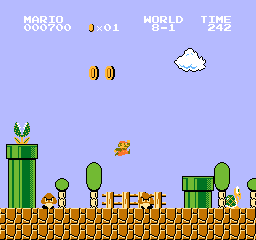
In the original Final Fantasy, on the other hand, the rules of the world were not rules controlling complex movement as in Super Mario Brothers. The characters and their actions were representative, rather than direct. You moved your party all at once, indicated by a single iconic character figure, and the details of their progression over various terrain were of no consequence to the game. The rules of the game were instead limited to what terrain was passable, basic interaction with NPCs, including speech, trade, etc., and the complex mechanics governing combat. Each character class had its own path of development, endowing the character with the ability to cast new spells, perform new attacks, or deal greater damage.

Both of these examples, despite being drastically different styles of gameplay, are similar in that they are both directed narratives. In Super Mario Brothers, you move from left to right, with the only opportunities from deviation occurring when warp-zones are found. In Final Fantasy, the game state is advanced by talking to the right character, learning the next step, undertaking that specific step, and so on, repeated until the final boss is defeated. The path that the developer has created is the path to game completion. In Final Fantasy, you may have decided to create a party of all mages, but the overall story, who you speak to, and what you must do to progress, will essentially remain the same. There is, however, a separate class of gameplay that has become increasingly popular more recently. That is, the sandbox game type, which depends largely on the player to direct the narrative. The basic rules and elements are provided, as before, but the actual progression is an undirected emergence from the player's usage of those elements within the gameworld. In The Sims, for instance, the player is loosely directed by economic factors; find work and earn money to purchase new goods. However, the majority of short-term goals, conflicts, and enjoyable gameplay sequences occur as a result of the player's actions. Whether players were interested in actually building the house, or the interpersonal relationships that their characters developed, the majority of goals and actions were not directly scripted by the game designer. It is an act of trust on the part of the game designer that the rules they have created and the tools they have given the player will be suitable to allow the player to craft their own satisfying gameplay experience.

Logically, the ultimate promise of videogames would be the potential for an epic interactive narrative, one were the player is the main character in a vast, rich universe of their choosing. Unfortunately, this is generally not the case, as many of the games offering sandbox play are limited to more rudimentary interactions. For instance, you will never get to read a touching poem one of your characters in The Sims has written about their recently departed family member that you caused to starve to death by luring them into the bathroom and removing the door. Conversely, those games with the most well-developed narratives, including voice acting, clever writing, and plot twists, are generally the most heavily scripted by the game developer. The path to completion in a game such as Final Fantasy 12 is so heavily directed that the actual freedoms the player experiences are of almost no consequence to the story whatsoever.

Inevitably, games are compared to movies and other less interactive forms of entertainment, and the argument is commonly made that the freedom and interaction games allow are what set them apart, but, as this Thinking Games blog post has argued, the scripted nature of many epic games makes them essentially the same. The gameworld is not a vast, functional universe. Instead, it is often a well-crafted facade, set up to appear open to the direction of the player. However, the actual opportunity to alter the experience is limited. Instead, many game developers are content to decide the entirety of the story and merely implement portions of the sandbox. Mario is a good example of this. The way you play out the given scenario on-screen is your own choice, but overall, you will progress in a linear fashion. Role playing games, by virtue of their very title, face an intrinsic conflict in design as they are, at their most basic, not meant to allow the player to deviate in their role in any way. The player serves as little more than a tool to increment the game state. Despite this, it is clear the ultimate goal of the RPG is to craft a fully realized universe in a box.

Trends in RPG development bear this out, and the movement towards ever more comprehensive gameworlds illustrates the inherent conflict. Oblivion, for instance, strives to create the feel of the sandbox, the utterly open world with which the player can do as they see fit, while also populating the world with a wide range of characters that interact in sophisticated ways. Unlike a movie, the goal of a game such as Oblivion is to give the player the power to be the star, but the reality of the game falls short. In fact, infinite play-throughs of Oblivion will not yield infinite outcomes. To satisfy the feeling of choice, the characters are given a wider range of scripted responses, allowing some variability, but the player is still ultimately limited to the paths the developer has chosen. The outcomes of the various quests and the results of conversations with NPCs will never deviate from these paths, except where the player has managed to break the game.

So will videogames ever manage to successfully create a complete world for the player to retreat to, while still maintaining a level of complexity that will allow the interactions to deliver the sort of dramatic impact that a movie like Star Wars has? That would be the holy grail of game development. It is my belief that sandbox games are a step in the right direction. As they develop in sophistication, the lexicon of meaningful interactions increase. The range of actions and responses that the self-motivated characters within a given sandbox game can make will continue to increase until they are very close to approximating the scripted actions of a linear narrative game. In the meantime, we have plenty of MMOs in which the other characters are actual humans. It is unfortunate that the quest direction, over-arcing story, and enemies are generally computer-controlled, but that is a topic for another column.

In the original Final Fantasy, on the other hand, the rules of the world were not rules controlling complex movement as in Super Mario Brothers. The characters and their actions were representative, rather than direct. You moved your party all at once, indicated by a single iconic character figure, and the details of their progression over various terrain were of no consequence to the game. The rules of the game were instead limited to what terrain was passable, basic interaction with NPCs, including speech, trade, etc., and the complex mechanics governing combat. Each character class had its own path of development, endowing the character with the ability to cast new spells, perform new attacks, or deal greater damage.

Both of these examples, despite being drastically different styles of gameplay, are similar in that they are both directed narratives. In Super Mario Brothers, you move from left to right, with the only opportunities from deviation occurring when warp-zones are found. In Final Fantasy, the game state is advanced by talking to the right character, learning the next step, undertaking that specific step, and so on, repeated until the final boss is defeated. The path that the developer has created is the path to game completion. In Final Fantasy, you may have decided to create a party of all mages, but the overall story, who you speak to, and what you must do to progress, will essentially remain the same. There is, however, a separate class of gameplay that has become increasingly popular more recently. That is, the sandbox game type, which depends largely on the player to direct the narrative. The basic rules and elements are provided, as before, but the actual progression is an undirected emergence from the player's usage of those elements within the gameworld. In The Sims, for instance, the player is loosely directed by economic factors; find work and earn money to purchase new goods. However, the majority of short-term goals, conflicts, and enjoyable gameplay sequences occur as a result of the player's actions. Whether players were interested in actually building the house, or the interpersonal relationships that their characters developed, the majority of goals and actions were not directly scripted by the game designer. It is an act of trust on the part of the game designer that the rules they have created and the tools they have given the player will be suitable to allow the player to craft their own satisfying gameplay experience.

Logically, the ultimate promise of videogames would be the potential for an epic interactive narrative, one were the player is the main character in a vast, rich universe of their choosing. Unfortunately, this is generally not the case, as many of the games offering sandbox play are limited to more rudimentary interactions. For instance, you will never get to read a touching poem one of your characters in The Sims has written about their recently departed family member that you caused to starve to death by luring them into the bathroom and removing the door. Conversely, those games with the most well-developed narratives, including voice acting, clever writing, and plot twists, are generally the most heavily scripted by the game developer. The path to completion in a game such as Final Fantasy 12 is so heavily directed that the actual freedoms the player experiences are of almost no consequence to the story whatsoever.

Inevitably, games are compared to movies and other less interactive forms of entertainment, and the argument is commonly made that the freedom and interaction games allow are what set them apart, but, as this Thinking Games blog post has argued, the scripted nature of many epic games makes them essentially the same. The gameworld is not a vast, functional universe. Instead, it is often a well-crafted facade, set up to appear open to the direction of the player. However, the actual opportunity to alter the experience is limited. Instead, many game developers are content to decide the entirety of the story and merely implement portions of the sandbox. Mario is a good example of this. The way you play out the given scenario on-screen is your own choice, but overall, you will progress in a linear fashion. Role playing games, by virtue of their very title, face an intrinsic conflict in design as they are, at their most basic, not meant to allow the player to deviate in their role in any way. The player serves as little more than a tool to increment the game state. Despite this, it is clear the ultimate goal of the RPG is to craft a fully realized universe in a box.

Trends in RPG development bear this out, and the movement towards ever more comprehensive gameworlds illustrates the inherent conflict. Oblivion, for instance, strives to create the feel of the sandbox, the utterly open world with which the player can do as they see fit, while also populating the world with a wide range of characters that interact in sophisticated ways. Unlike a movie, the goal of a game such as Oblivion is to give the player the power to be the star, but the reality of the game falls short. In fact, infinite play-throughs of Oblivion will not yield infinite outcomes. To satisfy the feeling of choice, the characters are given a wider range of scripted responses, allowing some variability, but the player is still ultimately limited to the paths the developer has chosen. The outcomes of the various quests and the results of conversations with NPCs will never deviate from these paths, except where the player has managed to break the game.

So will videogames ever manage to successfully create a complete world for the player to retreat to, while still maintaining a level of complexity that will allow the interactions to deliver the sort of dramatic impact that a movie like Star Wars has? That would be the holy grail of game development. It is my belief that sandbox games are a step in the right direction. As they develop in sophistication, the lexicon of meaningful interactions increase. The range of actions and responses that the self-motivated characters within a given sandbox game can make will continue to increase until they are very close to approximating the scripted actions of a linear narrative game. In the meantime, we have plenty of MMOs in which the other characters are actual humans. It is unfortunate that the quest direction, over-arcing story, and enemies are generally computer-controlled, but that is a topic for another column.
Nov 20, 2006
The Count | Top 6 Overrated Videogames
I've had a serious bone to pick with the videogame journalism establishment since 2002. You see, the community of players and journalists is small and sometimes a bit incestuous, so it's only natural that opinions and ideas can become a little contagious. That's why we have top 10 and top 100 lists published and recited and recreated ad infinitum, each one managing a strange sort of revision of the past that has evolved into a twisted group history that everybody recalls in the first person, like it happened to them and they've felt the same from the start. So what happened in 2002? The EGM top games of all time list happened, and it's managed to screw up videogame history ever since. That's why I'm going to do my little part to set things straight. I bring you, the top 6 overrated games of all time.

Super Metroid - Back in 2002, EGM chose this as the greatest game of all time, and all of a sudden Super Metroid is universally adored. Forget that. I was alive back when it came out, I had it, I should know. There is no way in hell this is the best game of all time. Metroid was a great game, it had no glaring flaws, and was generally a strong update of the original. It added some decent but unobtrusive story elements, a few items and abilities, and great boss battles to the mix, but it was not by any stretch a drastic reenvisioning of the platformer. This is just a sequel. It's a good one, but it didn't somehow knock the planet off its axis when it came out.
When I think of the best games of all time, I think of games that actually changed something, like Super Mario 3, the single greatest game for the original NES, and the embodiment of platforming perfection. I tend to think of Tie-Fighter, a masterpiece of accessible space flight-sim mechanics, or Zelda: Ocarina of Time. So while I'm here thinking of Half-Life 2, the most playable, smoothly controlling, and brilliantly paced and evisioned story-based fps ever, or Fallout, the single greatest rpg of all time, one that an entire generation of fans want a sequel for so bad that they are willing to build it themselves, EGM came out with this Super Metroid garbage and everybody started parroting them. Sure it's a good game, but calling it the best ever is an insult to all the games that really did something new and amazing. Now I'm done with this game forever. Let's never mention it again.
Resident Evil - This game came out to good but not perfect reviews. Why? The controls were horrible, the voice acting was a joke, and the gameplay consists of the type of nonsense, do a sliding puzzle to unlock a door crap that I have prayed for years that videogames would just get past. Tacking on a random puzzle doesn't equal good gameplay. It doesn't even make sense. Nobody builds houses like that.
Resident Evil did a lot of things right. It was the first survival horror game, creating an entirely new genre. More importantly, this is the game that gave everybody that classic scare when the dogs jumped through the window. That's awesome, but the key factor here is this is a game that you enjoyed despite the poor gameplay mechanics. It deserves its place in history, but more as a brilliant idea that had its flaws than as one of the greatest videogame masterpieces of all time.
Goldeneye - This game deserves some love because it was the first fps to actually manage to be decent for the console. Congratulations. Can you hear my disinterested golf clap? In August, 1997 when Goldeneye was released, I had already been playing Duke Nukem 3D on my PC for a year and a half. I was playing without the blurry television graphics and the horribly slow and imprecise controller aiming.
Everybody lovingly remembers Goldeneye's multiplayer, and granted, it was good for a console fps, but I was already used to Doom and Duke 3D where I didn't have to split my screen. Half of the maps my friends and I played in Duke 3D were user made, good luck finding that on your N64. Even better, Duke 3D had taunts you could say to each other, holograms you could use to trick people, remote-detonating pipe bombs, the ability to shrink and stomp each other, and freaking jetpacks. In Goldeneye you couldn't even jump. So here's Goldeneye in a nutshell: great multiplayer experience for those who were horribly deprived.
Ico - People love to trot this one out and talk about games as art. It had a nice atmosphere, but all of the mystery came from the fact that nobody really talked and the storyline was basically incomprehensible. Also, everything was brown. Then, 3 hours later, your mostly acceptable gameplay experience ended. If they didn't call this art, would anybody still talk about it?
Final Fantasy 7 - Oh yes, the grand-daddy of all overrated games, Final Fantasy 7. I played it and enjoyed it, like a lot of others, but do you know why Final Fantasy 7 is really overrated? The Playstation made videogames more mainstream than ever before and Final Fantasy 7 just happened to be the first rpg that the kiddy PS-X generation happened to play. Nice, but nobody claiming this is one of the best games ever has any real street cred.
The real gamers had already played Final Fantasy 6, released as Final Fantasy 3 in the US. FF6 elevated videogame story, character development, and especially music to a brilliant new height. The world was vast and changed dramatically over the course of the game. The battle system was highly customizable and, with mastery, allowed you to effectively decimate your opponents. All of the mini-games, underwater sequences, and flight sequences started here. FF6 was the original videogame equivalent of the big-budget Hollywood blockbuster. FF7 was just an extension. Besides, Cloud was sort of a baby and the actions and development of the characters just didn't translate as well as they did in FF6, where, despite just being 2D sprites, you knew far more about the lives, feelings, and fears of your party-members than you ever did in FF7.
Diablo 2 - Last but not least, we have Diablo 2. I'm going to preface this one with a little info. I loved the original Diablo. The manual was full of brilliant satanic back-story, the music was completely incredible, and the eternal nighttime of the town, with its sparse but tortured inhabitants, combined with the increasingly horrific scenes you encountered as you returned again and again to the cursed cathedral, venturing deeper underground by yourself until you literally set foot in the pits of hell and encountered the devil himself, lent this game an enduring element of pervasive fear that only the greatest games or movies have managed to make me feel. The sheer creepiness of the catacombs, the first time you hear the soundtrack wash out to a chorus of children screaming, was maddening and amazing. Having met with and killed the devil himself, the game ends without you ever venturing beyond the town.
A little later, Diablo 2 came along to perfect the gameplay formula. But what was the formula? Clicking all over the place. A lot. Diablo 2 traded the single creepy town of the original for a number of vastly different continents that, basically, weren't that scary. Stripped of much of its dramatic tension, the game became an exercise in clicking all over the place, swinging your sword or casting your fireball at the same pallette-swapped enemies over and over, only with different names, strengths and resistances that scaled to match yours. My roommate used to run through the entire game over and over again to level his characters, gaining new equipment and abilities that amounted to absolutely nothing of lasting consequence as the enemies became more difficult to compensate. Welcome to the treadmill, before it offered even the ephemeral rewards that World of Warcraft does.
The single most interesting thing about Diablo 2 was the secondary economy that evolved around it. As the game was botted all to hell, the actual game currency devalued completely and powerful items became the new unit of currency for trade online. On the US East servers, the currency in use was the Stone of Jordan, or SOJ, that you traded other good drops to get. I believe Diablo 2 was one of the first videogames that, if you didn't get your account hacked, allowed you to generate real-world cash, something I have a sort of interesting past with. At any rate, I will talk about monetizing your online gameplay time another day. For now, all you need to know is the common game of Diablo 2 was generally an exercise in clicking from one side of the map to the other and rushing through the story objectives to get to the bosses with high-value drops. Over and over and over. That is, unless you had PindleBot doing the work for you. Then your average gameplay experience consisted of coming home, checking your loot, setting the bot again, and going out to watch a movie.
So that's my list. My beef with the videogame journalism community is finally over. Well, for now I guess. I don't really have many other overrated games. I mean, there's always 7th Saga, but nobody actually rated that grey, cartridge-shaped turd highly except Eddie, who somehow imagines that shoddy, characterless piece of crap has superior sound and graphics to all other SNES rpgs, including Final Fantasy 3 which had an ORCHESTRA. Good luck with that.
Nov 14, 2006
Gamers Grow Up: Taking Back Videogames
Up until now, videogames have been relegated to a sort of ghetto of artistic expression. Parent groups and sensationalist quasi-activists like Jack Thompson constantly remind us that games are for children, and the industry must be regulated in some sort of bizarre prohibition for the digital age. To them, videogames are not a legitimate arena for expression and first amendment laws do not apply. It's time we did something about that.
Retaking Videogames
We are the first generation to have grown up playing videogames our entire lives. From Atari to Nintendo and on down through the years, gaming has just been a fact of our existence. To us, videogames are nothing new, and we continue to play them as we get older. At this point, the majority of active gamers are over the age of 25, it is only economics that games will increasingly be designed for and sold to us, the adult gamers. So why is it that an opportunist like Jack Thompson can wield the power to incite a public backlash against a game that takes on adult subject matter even when it is marketted as such?
Perhaps it is because the word videogame itself is perceived solely as the domain of children. As Doug Lowenstein, the chairman of the Electronic Software Association, or the ESA, the group that represents the game industry, believes. In a recent keynote address, Lowenstein argued that videogames would be taken more seriously if they were called something more serious, like entertainment software. A name is just a name, but he may have a point. It is not the reality of games so much as the perception of them that has made them a target. Whether it is that simple to just call them something else, though, is another matter. There are other points in the debate that require addressing.
A Game By Any Other Name...
The argument about games being art is an old one, but we need to move past it. Art is just a word, with a lot of associated meanings. Ask people to define the word art, and you will probably get as many separate answers as people. Likewise, people can think of games however they so choose. One thing that is not debateable however, is the fact that games are a way of telling stories and conveying ideas. Different from books, tv, or movies, games empower the gamer, so the actual story is a collaboration between the developer and the player, but this in no way lessens the value of the message you take from it. If anything, it increases it. Whether or not games fit into an arbitrarily defined framework of art is irrelevant. As a medium of expression, the same first amendment rights should be extended to videogames.
Similarly, the impact of violent videogames on developing children has no place in this debate. Even the famous study that Jack Thompson frequently cites uses the language "violent media." Violent media includes television and movies, and is not limited to videogames. Nobody protests when an R-rated movie is released, regardless of whether or not the violence depicted therein may endanger young minds. It would be absurd to do so. Movies are made for and marketted to adults and children separately. There is no reason why videogames should be handled any differently.
How to Fight Back
The debate for what is accepable in videogames is ongoing, but we can't win if we don't participate. The lack of a powerful videogame lobby group makes us an easy target, politically. The ESA has time and again proven insufficient to combat the alarmism and widespread misinformation surrounding videogames. Parents and newscasters have been making outright incorrect statements publically, saying things like in Bully you play as a bully yourself, or that you are able to injure teachers. The public uproar surrounding Bully characterizes where the ESA falls short. The ESA's response to these blatantly wrong statements was minimal. A proper lobbying organization would have, at the very least, gone on the air correcting these statements. Where the ESA should have been working to reform this negative image, publicizing the actual facts, and making attempts to connect with and calm concerned parents, it was doing nothing. Either the ESA requires further funding from its members, primarily large game publishers, or a secondary lobby should be established.
One of those things has already happened. The Entertainment Consumer's Association, or the ECA, was founded recently to act as the voice of gamers such as ourselves. It is a non-profit advocacy group devoted to providing us some political protection as consumers. On the site, you can learn which states have game censorship legislation in progress and which politicians are sponsoring that legislation. The goal of the ECA is to let those politicians know that gamers are an enormous body of voters that care about keeping videogames protected by laws of free speech. You can join the ECA for about $20 as well, which gets you some extras like free issues of EGM and the positive feeling that you have done something to help keep videogames free.
It is important to note that the ESRB, the ratings system run by the ESA, has come under fire as well since the Hot Coffee mod as being insufficient to properly rate games and inform consumers. Despite this, it is arguably better for the ESRB to remain in place, as the alternative would be a rating system imposed from outside of the game industry, allowing a political group to force game developers to alter their content to get better ratings, similar to the MPAA in Hollywood.
The Moral of the Story
Even though videogame censorship advocates like Jack Thompson didn't succeed in getting Bully pulled from store shelves in the United States, they have succeeded in making videogame violence a serious issue. In many different states, there are new laws regulating and outlawing the sale of certain games, the first step in the road to more severe forms of censorship. In Britain, Bully has been pulled from the shelves of several large retailers, despite actually being relatively non-violent. If we are going to avoid the same fate, we, as the first generation to grow up playing videogames, must take responsibility.
We are the first generation to have grown up playing videogames our entire lives. From Atari to Nintendo and on down through the years, gaming has just been a fact of our existence. To us, videogames are nothing new, and we continue to play them as we get older. At this point, the majority of active gamers are over the age of 25, it is only economics that games will increasingly be designed for and sold to us, the adult gamers. So why is it that an opportunist like Jack Thompson can wield the power to incite a public backlash against a game that takes on adult subject matter even when it is marketted as such?
Perhaps it is because the word videogame itself is perceived solely as the domain of children. As Doug Lowenstein, the chairman of the Electronic Software Association, or the ESA, the group that represents the game industry, believes. In a recent keynote address, Lowenstein argued that videogames would be taken more seriously if they were called something more serious, like entertainment software. A name is just a name, but he may have a point. It is not the reality of games so much as the perception of them that has made them a target. Whether it is that simple to just call them something else, though, is another matter. There are other points in the debate that require addressing.
The argument about games being art is an old one, but we need to move past it. Art is just a word, with a lot of associated meanings. Ask people to define the word art, and you will probably get as many separate answers as people. Likewise, people can think of games however they so choose. One thing that is not debateable however, is the fact that games are a way of telling stories and conveying ideas. Different from books, tv, or movies, games empower the gamer, so the actual story is a collaboration between the developer and the player, but this in no way lessens the value of the message you take from it. If anything, it increases it. Whether or not games fit into an arbitrarily defined framework of art is irrelevant. As a medium of expression, the same first amendment rights should be extended to videogames.
Similarly, the impact of violent videogames on developing children has no place in this debate. Even the famous study that Jack Thompson frequently cites uses the language "violent media." Violent media includes television and movies, and is not limited to videogames. Nobody protests when an R-rated movie is released, regardless of whether or not the violence depicted therein may endanger young minds. It would be absurd to do so. Movies are made for and marketted to adults and children separately. There is no reason why videogames should be handled any differently.
The debate for what is accepable in videogames is ongoing, but we can't win if we don't participate. The lack of a powerful videogame lobby group makes us an easy target, politically. The ESA has time and again proven insufficient to combat the alarmism and widespread misinformation surrounding videogames. Parents and newscasters have been making outright incorrect statements publically, saying things like in Bully you play as a bully yourself, or that you are able to injure teachers. The public uproar surrounding Bully characterizes where the ESA falls short. The ESA's response to these blatantly wrong statements was minimal. A proper lobbying organization would have, at the very least, gone on the air correcting these statements. Where the ESA should have been working to reform this negative image, publicizing the actual facts, and making attempts to connect with and calm concerned parents, it was doing nothing. Either the ESA requires further funding from its members, primarily large game publishers, or a secondary lobby should be established.
One of those things has already happened. The Entertainment Consumer's Association, or the ECA, was founded recently to act as the voice of gamers such as ourselves. It is a non-profit advocacy group devoted to providing us some political protection as consumers. On the site, you can learn which states have game censorship legislation in progress and which politicians are sponsoring that legislation. The goal of the ECA is to let those politicians know that gamers are an enormous body of voters that care about keeping videogames protected by laws of free speech. You can join the ECA for about $20 as well, which gets you some extras like free issues of EGM and the positive feeling that you have done something to help keep videogames free.
It is important to note that the ESRB, the ratings system run by the ESA, has come under fire as well since the Hot Coffee mod as being insufficient to properly rate games and inform consumers. Despite this, it is arguably better for the ESRB to remain in place, as the alternative would be a rating system imposed from outside of the game industry, allowing a political group to force game developers to alter their content to get better ratings, similar to the MPAA in Hollywood.
Even though videogame censorship advocates like Jack Thompson didn't succeed in getting Bully pulled from store shelves in the United States, they have succeeded in making videogame violence a serious issue. In many different states, there are new laws regulating and outlawing the sale of certain games, the first step in the road to more severe forms of censorship. In Britain, Bully has been pulled from the shelves of several large retailers, despite actually being relatively non-violent. If we are going to avoid the same fate, we, as the first generation to grow up playing videogames, must take responsibility.
Nov 12, 2006
Rumble | Blu-Ray Versus HD DVD
It's that time of the week again, time to prostrate ourselves, submit our two combatants to the Google altar and let the group mind decide the victor. This week, in typical inflammatory fashion, I have decided the battle will be between Blu-Ray, in blue, and HD DVD, in red.

It has been decided. HD DVD wins. You can run the trend search for yourself here
It remains to be seen what the Playstation 3 will do for Blu-Ray, but as of now HD DVD sales outstrip Blu-Ray by 33% according to Wikipedia. Either way, I'll stick to getting my movies the old-fashioned way, divx.

It has been decided. HD DVD wins. You can run the trend search for yourself here
It remains to be seen what the Playstation 3 will do for Blu-Ray, but as of now HD DVD sales outstrip Blu-Ray by 33% according to Wikipedia. Either way, I'll stick to getting my movies the old-fashioned way, divx.
Nov 10, 2006
A Little Introduction
 |
I have no specific love for any consoles or companies either, regardless of what you think after reading the PS3 will fail article. I gave up any sense of fanboyism a long time ago, when Nintendo released broken console after broken console. That being said, I have no problem showing respect when a company gets it right. Even though I honestly think the PS3 stands a good chance of failure, I also think it is a truly awesome piece of technology and want one on those grounds alone. Also, something important about me, I have an incredibly short attention span for games that are just not fun to play. When I was younger I could sit through 10,000 random battles in Final Fantasy, but right now I'm not interested in tolerating crap to get to the hidden fun parts of a game. I don't care how good the story is, if it is meant to be a polished, complete package, it better be fun from start to finish.
One thing that will become abundantly clear over the next few weeks, I have a black, black heart. I do love innovation though. I'm really interested in the overriding gameplay philosophy behind games. That, and the community that's grown up around them. Well, I'm interested in a lot of things. My goal is to seriously explore them all in my writing.
 |
I generally judge games on their individual merits, rather than genre or developer, but I tend to really enjoy action-adventures and RPGs, and am a sucker for well-written narrative and epic storytelling, as well as games with good artistic design, and "styyyyle," as I like to call it. I love the classics, and at risk of sounding like a fanboy, (especially after our last few articles) Mario and Zelda games rock my socks. =-o Something I very much enjoy is rigorous mental stimulation when I play a game - like a full-brain massage. Anything off the beaten path interests me, and horror games hold a special place in my heart. I absolutely HATE when a game feels like a chore, and I get sick of sequels quickly. Don't bore me, and please give me NEW stuff!
In my writing, I plan to approach overlooked aspects of gaming with a unique perspective, and hopefully provide some intelligent discourse.
As a general rule, while Brian is eager to crush games, I seem to end up having a crush on them...
Nov 9, 2006
Why The PS3 Will Fail
Sony's strategy entering this console generation has been fundamentally flawed from the start. As Nintendo has demonstrated, customer good-will from previous console generations can only extend so far. If your console is basically flawed, it will be relegated to a distant thirdplace in the ongoing battle for market-share. In the case of Nintendo, where the Nintendo 64 and the Gamecube were both highly flawed but still profitable, that was an acceptable situation. With the PS3 though, Sony is incurring a huge loss with every console sale. Banking on the widespread success of the PS3, Sony expects to recoup those losses in software sales, so ending up in the third place position would be a death knell for Sony. Sony has to know everything's on the line here right? So why are they handling the PS3 the way they are?

Format Wars
I can see exactly what Sony is shooting for with Blu-Ray. Sony has claimed that the PS2 was instrumental to the success of the DVD format, with some degree of truth. The PS2's release was perfectly positioned during a period when more and more movies were seeing DVD releases but stand-alone DVD players were still $100-$200. The PS2, at $300, offered DVD player capabilities and the additional perk of gaming, clearly a great value. Being able to play DVDs obviously drove up PS2 sales.
But Blu-Ray isn't the DVD format. There are very few movies currently out in Blu-Ray formats, and Blu-Ray does not offer a user experience that is vastly different from DVD in the way that DVD introduced commentary, separate language tracks, and various other advanced features that VHS lacked. Further, there are currently no stand-alone Blu-Ray players available for less than $900. Even then, only some of the exorbitantly priced players offer proper support for full 1080p at this point, and the initial wave of players only supported MPEG2 compression. Implementation of the Blu-Ray standard has been inconsistent, and where DVD was the clear successor to the VHS format, Blu-Ray is in competition with another format, HD-DVD, which has already received the backing of Microsoft, Universal Studios, and other prominent movie studios. Whether or not Blu-Ray will take off the way DVD did is very much up in the air. It doesn't help that a cheaper alternative is already widely available. The demand for Blu-Ray that Sony imagines will position the PS3 as a great value to home entertainment enthusiasts does not exist.
Unfortunately for Sony, every single other facet of the PS3 has been compromised to maintain Blu-Ray support. The cost of the console itself is vastly increased by the implementation of this new technology. Likewise, actual console production has been drastically reduced due to manufacturing issues with the new technology. In a bid to save money, the PS3 architecture has been hamstrung, and the PS3 is left going into the new console generation with only 256MB of RAM. Where Sony has been trying to market the PS3 as a sort of cut-rate computing experience, including support for USB keyboards and mice, the system is clearly deficit. My PC from 2002 had more than 256MB of RAM.
Sony's Inferiority Complex
Besides Blu-Ray, the PS3 also possesses one other completely new technology. That is the Cell processor that Sony has claimed is on-par with a supercomputer. This technology proved decent for generating buzz early on, with articles claiming use of the processors by scientists for mass computing problems, but now you don't hear much about it. Why is that? Because CPUs don't sell consoles. The buying public doesn't actually care that much. The PS2 was the weakest of all the previous generation systems, and yet it was far and away the most successful.
Perhaps criticism of the PS2 has given Sony something of a complex, resulting in Kutaragi risking it all to compete in the hardware specs pissing match. Either way, the PS3 is now saddled with yet another piece of new technology for which the manufacturing process has not yet been perfected. The PS3 ends up being that much harder to produce and that much more expensive.

Advertising Woes?
Finally, you have Sony PR which has been one disaster after another. However, Sony PR has arguably always been a mixed bag. From the original Playstation on, Sony has pushed ads that are edgy, running the gamut from disturbing, to potentially racist, to outright confusing. The secret code in some print ads for the PS3 recalls to mind the original cryptic Playstation ads, which left to the reader the task of decoding messages such as "you are not ready."
I remember feeling that the buzz surrounding the release of the original Playstation was palpable. This time around, Sony is doing roughly the same things it did before, advertising-wise. The feeling is much more negative this time around, but even negative buzz works in Sony's favor. However, it remains to be seen whether or not Sony, mired in manufacturing woes, will be able to actually provide the consoles to match the interest they have generated, which brings me to my final point.
Solid Alternatives
Parents and other consumers are going to go shopping this christmas, and they are going to go in wanting a PS3 and leave with an Xbox 360 or a Nintendo Wii. There are already claims that the PS3 is on-par with the 360 in terms of processing power, which I am very skeptical of. However, it is unarguable that Wii and the 360 are both much cheaper (no matter how you try to spin it) and much more widely available than the PS3. It is unclear when Sony will ever be able to get it's manufacturing act together, but the 360 has been out for a long time and faces no production shortages. Similarly, Wii production outstrips PS3 production by an entire order of magnitude.
Consumers simply will not have the option of getting the PS3 when it counts. With the Xbox 360 aimed at the same target audience as the PS3, and already being widely available and popular with developers, and the Wii attempting to create it's own complementary market, Sony's prospects for success appear grim. Perhaps it will be sustained through this period by the Japanese market, which has relatively little interest in the 360 and thus represents an entire hard-core gamer segment that is ripe for the taking, but the decline of the videogame market in Japan has been ongoing for years. Cheaper, more accessible, and innovative experiences, such as that offered by the Nintendo DS, have been dramatically more successful than traditional hardware upgrade iterations such as the PSP. Sony's future remains very much in question.

The PS3's future is in question
Format Wars
I can see exactly what Sony is shooting for with Blu-Ray. Sony has claimed that the PS2 was instrumental to the success of the DVD format, with some degree of truth. The PS2's release was perfectly positioned during a period when more and more movies were seeing DVD releases but stand-alone DVD players were still $100-$200. The PS2, at $300, offered DVD player capabilities and the additional perk of gaming, clearly a great value. Being able to play DVDs obviously drove up PS2 sales.
But Blu-Ray isn't the DVD format. There are very few movies currently out in Blu-Ray formats, and Blu-Ray does not offer a user experience that is vastly different from DVD in the way that DVD introduced commentary, separate language tracks, and various other advanced features that VHS lacked. Further, there are currently no stand-alone Blu-Ray players available for less than $900. Even then, only some of the exorbitantly priced players offer proper support for full 1080p at this point, and the initial wave of players only supported MPEG2 compression. Implementation of the Blu-Ray standard has been inconsistent, and where DVD was the clear successor to the VHS format, Blu-Ray is in competition with another format, HD-DVD, which has already received the backing of Microsoft, Universal Studios, and other prominent movie studios. Whether or not Blu-Ray will take off the way DVD did is very much up in the air. It doesn't help that a cheaper alternative is already widely available. The demand for Blu-Ray that Sony imagines will position the PS3 as a great value to home entertainment enthusiasts does not exist.
Unfortunately for Sony, every single other facet of the PS3 has been compromised to maintain Blu-Ray support. The cost of the console itself is vastly increased by the implementation of this new technology. Likewise, actual console production has been drastically reduced due to manufacturing issues with the new technology. In a bid to save money, the PS3 architecture has been hamstrung, and the PS3 is left going into the new console generation with only 256MB of RAM. Where Sony has been trying to market the PS3 as a sort of cut-rate computing experience, including support for USB keyboards and mice, the system is clearly deficit. My PC from 2002 had more than 256MB of RAM.
Sony's Inferiority Complex
Besides Blu-Ray, the PS3 also possesses one other completely new technology. That is the Cell processor that Sony has claimed is on-par with a supercomputer. This technology proved decent for generating buzz early on, with articles claiming use of the processors by scientists for mass computing problems, but now you don't hear much about it. Why is that? Because CPUs don't sell consoles. The buying public doesn't actually care that much. The PS2 was the weakest of all the previous generation systems, and yet it was far and away the most successful.
Perhaps criticism of the PS2 has given Sony something of a complex, resulting in Kutaragi risking it all to compete in the hardware specs pissing match. Either way, the PS3 is now saddled with yet another piece of new technology for which the manufacturing process has not yet been perfected. The PS3 ends up being that much harder to produce and that much more expensive.

A Playstation 10th Year Anniversary ad that was pulled following protest by the Vatican
Advertising Woes?
Finally, you have Sony PR which has been one disaster after another. However, Sony PR has arguably always been a mixed bag. From the original Playstation on, Sony has pushed ads that are edgy, running the gamut from disturbing, to potentially racist, to outright confusing. The secret code in some print ads for the PS3 recalls to mind the original cryptic Playstation ads, which left to the reader the task of decoding messages such as "you are not ready."

The so-called racist ad
I remember feeling that the buzz surrounding the release of the original Playstation was palpable. This time around, Sony is doing roughly the same things it did before, advertising-wise. The feeling is much more negative this time around, but even negative buzz works in Sony's favor. However, it remains to be seen whether or not Sony, mired in manufacturing woes, will be able to actually provide the consoles to match the interest they have generated, which brings me to my final point.
Solid Alternatives
Parents and other consumers are going to go shopping this christmas, and they are going to go in wanting a PS3 and leave with an Xbox 360 or a Nintendo Wii. There are already claims that the PS3 is on-par with the 360 in terms of processing power, which I am very skeptical of. However, it is unarguable that Wii and the 360 are both much cheaper (no matter how you try to spin it) and much more widely available than the PS3. It is unclear when Sony will ever be able to get it's manufacturing act together, but the 360 has been out for a long time and faces no production shortages. Similarly, Wii production outstrips PS3 production by an entire order of magnitude.
Consumers simply will not have the option of getting the PS3 when it counts. With the Xbox 360 aimed at the same target audience as the PS3, and already being widely available and popular with developers, and the Wii attempting to create it's own complementary market, Sony's prospects for success appear grim. Perhaps it will be sustained through this period by the Japanese market, which has relatively little interest in the 360 and thus represents an entire hard-core gamer segment that is ripe for the taking, but the decline of the videogame market in Japan has been ongoing for years. Cheaper, more accessible, and innovative experiences, such as that offered by the Nintendo DS, have been dramatically more successful than traditional hardware upgrade iterations such as the PSP. Sony's future remains very much in question.
Subscribe to:
Posts (Atom)