Showing posts with label Crap. Show all posts

Nov 6, 2009

Not A Happy Ending -- Fairytale Fights Review

The thought of taking traditional fairy-tale characters, warping them, and throwing them into a twisted and violent storybook world is clearly a great idea. Who wouldn't want to play a game based on such a premise? Well, if the only way to do so is via Playlogic's Fairytale Fights, then maybe the answer to that question is you.

Fairytale Fights is a 3D beat-em-up action title with platforming elements that places players in the roles of Little Red Riding Hood, Snow White, Jack (of beanstalk fame), or the Naked Emperor, and sets them off on an adventure through a linear world that is inspired by children's books, but is as demented as the psychiatric ward. Characters like ginger bread men, gnomes, and wolves attack at every turn, so players must make use of an extensive arsenal of blunt, sharp, ranged, and magical weapons to brutally (yet somehow seemingly light-heartedly) massacre them all.
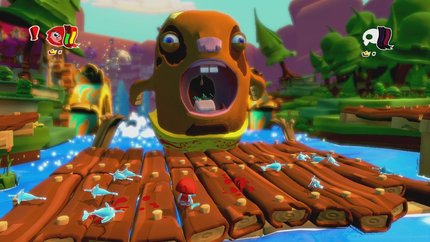
Fairytale Fights

The game has its own little brand of humor, most evident in the sarcastic quips in characters' speech bubbles, but also a bit more discretely present in the background goings-on in each of the game's levels. As for the buckets of brightly colored, smoothly polygonal blood that spills everywhere as Little Red Riding Hood cuts lumberjacks in half with a swordfish skeleton, it's mostly just gratuitous, pointless, and immature. I tried to tap into the most childish centers in my brain to appreciate it, but came back with a response that more closely approximated something like, "Is this really happening? Is she skating on a puddle of blood? Is that necessary?"

This lack of willingness to entirely acquiesce to the game's humor most likely stems from the limited fun to be had with the actual gameplay. The controls feel awkward and unnatural in nearly every way. To start, movement is floaty, and characters too easily get caught on the layered and uneven, albeit interesting, terrain. Swapping weapons is a chore because there is no way to know if a weapon on the ground is better than the weapon in hand without hurling the latter across the screen to make room. Attacking is mapped to the right analog stick, but only ranged attacks are influenced by the direction in which the stick is pushed; melee attacks always go straight ahead in the direction the character is facing, and are not very precise. Characters get caught in unbreakable attack chains that send them swinging in the wrong direction, often leaping uncontrollably forward and plummeting to their doom. Either a regular attack button or consistency across weapon types would have at least helped a little.

The game features an "arena mode," which pits characters against one another in deadly, bloody combat, but because the controls are such a struggle to begin with, even playing against other local or online players is just a wild mess of stick wiggling. Drop-in/drop-out multiplayer works better in the game's story mode, so long as friendly fire is turned off and you can't go flailing into one another; playing with a friend makes this mode slightly more enjoyable... or rather, less painful.

The game's visual style is colorful and bright, and creates a strange and warped world of fairy tale settings and characters, but the overall quality of the graphics is sub-par by today's standards. the game looks dated, and sounds the same way. There is no voiced dialog in Fairytale Fights, and only some of the background tunes redeem the game's soundscape... if players make the effort to pay attention.

Fairytale Fights is built upon an interesting premise with great potential, but sprouts something far inferior to a magical beanstalk. While it can be briefly enjoyable and provide a few giggles and chuckles, it quickly becomes repetitive and boring. Cooperative play helps, but in the end, the poor controls and lack of genuinely entertaining qualities will drive most players away.

Nov 18, 2007

Fighting Golf Combat Racer -- Aqua Teen Hunger Force: Zombie Ninja Pro-Am Review

I knew that my luck would have to change someday. After reviewing Zack & Wiki, Super Mario Galaxy, and Assassin's Creed, I found myself staring into the beady little eyes of Aqua Teen Hunger Force: Zombie Ninja Pro-Am (ZNPA). This game regrettably contains neither zombies nor ninjas, and the only redeeming quality for this mess of a game are the non-gameplay portions of the disc's content.

If you are not a fan of Aqua Teen Hunger Force, then there is absolutely no reason to ever play this game. I happen to enjoy the cartoon, so I managed to siphon a fair amount of enjoyment out of the game, mostly from the four episodes of the show (one never-before seen) that reside in the Extras section, and the between-level cut scenes (which play out like another episode).

As for the game itself, it boils down to a sub-par golf game, a crappy beat-em-up, and an atrocious golf cart racer all rolled into one. The story that attempts to unify this strange combination is that Frylock receives a letter of acceptance into a golfing club and Master Shake takes control of the entire situation, stealing their neighbor Carl's car and heading out to play the most bizarre round of golf one could imagine.

[athf2.jpg]

Everything in ZNPA is as simple as can be. Players have the choice of a wood, two irons, a wedge, and a putter, but normally the point is just to hit the ball as far as possible without going off-course. After each shot, Shake and Frylock have to trek to the ball's resting place, fending off an onslaught of nearly every character from the series. The next shot can only be taken once every foe has been defeated, which can be quite the task sometimes. The methods by which these hostiles are dispatched are largely ineffective, from Shake's wild golf club flailing to Frylock's slow and inconsistent eye blasts. This is arguably the worst part of the game, but actually makes up the majority of it.

Occasionally, players will find themselves racing golf carts around a particular course, trying to grab boosts and bazookas in hopes of finishing first. This is done while enduring poor controls and the most frequently repeated lines of dialog ever experienced. On second thought, maybe this is the worst part of the game.

[athfznpa.jpg]

The graphics in ZNPA are not good at all. It's almost pointless to discuss its shortcomings in terms of frame rate, pop-in, textures, lighting, models, and the like, because the game is many generations behind the times, technically. The best parts of the entire presentation are the voice performances during the game's story segments. If one could extract these and put them all together in one continuous video, it would be more worthwhile than actually playing the game. At least it's possible to view them again in the Extras section.

My take-home message is this: do NOT buy this game if you aren't a big fan of the show. There is absolutely nothing here for you. If you do enjoy the show, still do NOT buy it. Rent it for the few hours it takes to experience the game and watch the included episodes, then don't think about it ever again.

Nov 12, 2007

You Got The Sunday Paper In My XBLA -- Word Puzzle Review

Have you ever opened up your favorite newspaper and headed straight for the crossword puzzle, jumble, cryptoquip, and word search residing somewhere in the middle? I have, and working on the four of those could be pretty enjoyable on a boring morning. Word Puzzle is basically like a full book of just one of those four (arguably the least stimulating one) - the word search.

For a whopping 800 MS points, players enjoy finding words on the traditional letter grids, as well as on irregularly-shaped arrangements and four-sided 3D boards. The game has a variety of play modes, although the goal is invariably "find the words" in any given situation.

The Arcade mode is somewhat of a joke, because while there are special bonuses for finding words in rapid succession and there is a [much too lengthy to be of any significance] time limit on each set of words, the game highlights the first or last letter of each. To put it plainly, this mode's utter lack of any challenge whatsoever makes it simply a waste of time. (Well, I rescind my statement. Those who don't know how to read will find this mode slightly challenging)

Survival mode is the cream of the Word Puzzle crop, and can actually become difficult during the final stage. The point in Survival mode is to locate all of the special 'bomb words' before the timer runs down. The best part is that the words are no longer tipped as in Arcade mode. Finding the other words on the list is unnecessary, because once the highlighted ones are crossed off, the player has successfully passed the level. Each of the eight three-puzzle areas comes complete with an extra bonus game where players must find as many words as they can within about 10 seconds.

Free Play mode is, again, valueless. Players choose a board style and game type (either themed words or synonyms/antonyms) and then go at it at their own pace. It gets old fast, and worse yet is that after a short stint of phonetic spelunking, words begin to recur often. This applies to all game modes.

Multiplayer exists in both local and online flavors. Players can compete in a single-grid race to locate the most words from a given list. The winners' bragging rights are minimal, but I'm sure some crazed competitive gamer will find a way to glorify these sorts of victories.

There isn't much more to say about Word Puzzle. It is your Sunday newspaper's word search with a little extra incentive and competitive play thrown, but the gameplay isn't as good. Plus, it will run you about $10, which to me is totally unacceptable. A one-week rental of a feature-length Xbox 360 title would certainly be more satisfying, and would leave you with enough money to buy yourself a snack or two.

Jun 26, 2007

Insignificant Life -- Innocent Life: A Futuristic Harvest Moon Review

Natsume's Harvest Moon series has been around the proverbial block. Since its early days on the Super Nintendo, the setting and plot have remained fairly consistent. Players would be responsible for taking a farm from its infancy to a fully functioning operation, and building a long-lasting relationship with a certain member of the virtual community. With Innocent Life: A Futuristic Harvest Moon, it appears that Natsume has been reaching for new ideas. What it has come up with is an oversimplified and much less charming version of it's beloved series.

Innocent Life is set in the near future, and stars an artificial life form called, interestingly enough, "Life." He has been created by a scientist named Dr. Hope in order to calm the angered spirits of Heartflame Island. These inhabitants of the heart-shaped island are at odds with the human population for bringing technology too far and are threatening to destroy civilization with a volcanic eruption. Apparently, they are okay with robot technology that comes in the SHAPE of a human, though, so Dr. Hope aims to appease them by having his AI Pinocchio restore the ruins of the island.

At the same time, Life is trying to become truly human, but must first learn the value of life...by nurturing life. In the process he will work to improve upon his human attributes of humor, creativity, cooking, intelligence, love, and challenge. Your guess as to what "challenge" entails is as good as mine. Life's traits improve when he eats, sleeps, works the farm, etc., bringing him ever closer to becoming a real boy.


Photo -


The premise sounds very promising, but in actuality, the game falters at every step. First of all, this is one of the slowest-paced games I've ever encountered, treating gamers to a tutorial-laden quasi-state of control for a full hour at the game's outset. For that entire time, the player's actions are restricted to clicking through dialog boxes and walking a maximum of two rooms before encountering the next block of drawn-out text. Additionally, there are long sequences describing how to equip and swing a hoe, plant seeds, and pour a watering can. These CANNOT be skipped or hurried along in any way. It would be VERY easy to put this game down in the early goings. I personally fought an intense internal battle to A) stay awake and B) keep the PSP running long enough to reach the actual gameplay. The experience was brutal.

When the player finally does take full control, there isn't really all that much to do. Life ends up being sent to bed around midday, simply in order to advance time and avoid boredom. The first time it rained in my game, I was told that I didn't have to water my crops. I instantly asked myself the question "What CAN I do?" At that point watering crops was my only option, so sleep cam around 10 AM. After a few weeks, even the primary tasks involved in maintaining a typical Harvest Moon farm are taken away, automated by a robot presented to him by Dr. Hope. The only action that remains for the player is to harvest and ship the plants once they are fully grown. Even the livestock are tended with some degree of automaticity, on top of the fact that the farm's capacity is limited to five animals per species.

With nothing to occupy the time, players are free to explore the surrounding areas in search of various wild plants, tool upgrades, and magic jewels. These jewels are of particular interest because they unlock new areas on Heartflame Island as well as opening up more farmable land. When it comes down to farming, each square is hoed and sowed individually, then watered each day - until your robot takes over, of course. Players run around with the PSP's analog stick and walk with the directional pad. The d-pad is useful for aligning Life precisely with each square of soil, but the game generally seems to handle that fairly well.

Basically, farming consists of shipping crops to buy more seeds - which grow more crops, and so on. Cash flows like water, so the rewards for playing eventually become non-existent. Other than more seeds to make more money, there isn't much else to buy. Tool upgrades are found for free via exploration, and there are no upgrades available to improve farm structures or living quarters. The piles of money one makes in Innocent Life are somewhat meaningless.

Photo -


The game is very story-driven compared to other Harvest Moon installments, where the player drives the story. Additionally, the entire narrative only spans a single year - not the normal 30-odd years Harvest Moon veterans are used to. Each Sunday, when Life goes to visit Dr. Hope, the state of the plot is advanced, revealing more of the story on Heartflame Island. Mostly all of the conversations that occur throughout the week are trivial. Social interaction as a whole is only a shadow of what could be found in previous Harvest Moon games. There are fewer festivals and events for Life to attend, and the characters that populate the town are about as interesting as slugs. More importantly, there is no courtship/flirting, no marriage, and no family life. Playing as a robot has given Natsume the opportunity to remove one of the biggest aspects of the Harvest Moon series. I guess robots aren't that good at mingling, anyway.

Innocent Life is not bad to look at. Although the water lacks detail and the trees sometimes look flat, there is a good deal of variety in the environments, and the art style does carry a certain aesthetic appeal. When the camera drops low in the areas outside of the farm, the background vistas can be quite attractive, and the perspective creates a fresh and inviting look. The music is not bad, but I wish there was more of it. The same handful of background songs accompany the action, throughout. If there was just more of a variety, then the pleasant guitars, violins, chimes, and other instruments could make an even better impression. As it stands now, the soundtrack quickly becomes repetitive.

If "the future" means a setting relatively identical to the present, with automated tasks and a few stylized items, along with the removal of any meaningful social interaction and culinary appreciation, then Innocent Life has hit the nail right on the head. As I played, I managed to piece together a short bill of truths about the game. I found that there is no reason to keep the main character awake, because there is nothing for him to do; there is no reason to socialize, because the non-player characters are boring and useless; there is no reason to buy items, because they can all be found; there is no reason to tend the farm, because an automatic robot helper takes care of that job; there is no reason to make money, because there is nothing to buy; and ultimately, there is no reason to play Innocent Life at all.